" Blog da Horta Biológica: Flower Garden
Mostrar mensagens com a etiqueta Flower Garden. Mostrar todas as mensagens

Potassium Hydroxide Liquid Soap for Garden Pests and Laundry

At the request of our Azorean readers, we're going to teach how to make potassium hydroxide / coconut soap for garden and orchard pests... and more!

First of all, we'd like to thank our readers for following us and trusting in our work, and we'd like to send a big hug to those of you who follow us from the wonderful islands of the Azores!

At the end of this post, you can also watch our educational video where we show you in detail how to make this soap.


For this post, we've formulated a soap that, in addition to having only only a few ingredients, is very effective at fighting pests in the garden and orchard, as well as washing clothes in the home laundry.

Let's start by looking at the ingredients and understanding why each one is used.


Ingredients


  • 141g Cold-pressed extra virgin coconut oil
  • 94g Extra virgin olive oil
  • 60,11g Potassium hydroxide (KOH), 90% pure *
  • 180,32g Distilled water


* Potassium hydroxide is highly hygroscopic, which means it has a strong ability to absorb moisture from the air. For this reason, as soon as it is weighed, it should be immediately sealed in its container, which must be well stored to prevent its deterioration. After sealing the bottle, we place it inside a tightly closed bag and store it in a cabinet to avoid contact with moisture. See the images in the video for a better understanding.


If you don't have a precision scale, round down, never round up.


Important: This soap does not have super fat, so it is not intended for use on the skin!


Why These Ingredients


First of all, it's important to remember that all the ingredients must be of high quality! Sometimes, when the soap is not made for skin use but for pests and laundry, there is a temptation to use low-quality oils. In this case, we strongly advise against it, since the purpose of this soap is also to nourish and care for the plants. 

On the other hand, we also want to stress that this formula has been calculated on the basis of pure oils. Each oil has its own saponification index, which means that if dubious oils are used (i.e. oils that are not truly extra virgin), the result could be a fiasco.

If you've never made soap before and aren't familiar with the process or the technical terms we are using, please read our post first: How To Make Soap.


Let's take a look at each of the ingredients:


  • Cold-pressed extra virgin coconut oil: coconut soap is extremely effective in controlling garden pests (find out more in our post Soap and Vegetable Oil Spray). Additionally, coconut is highly nutritious and is used as an organic fertilizer for the healthy growth and development of plants.
  • Extra virgin olive oil: the oil can be plain or macerated with pest-repellent plants such as peppermint, rosemary, thyme, etc. Find out more about macerations in our post How To Make a Maceration and more about plants and their uses in our book The 5 C's of Aromatic and Medicinal Plants. The use of olive oil in this formula has two functions. One is to add more beneficial properties to the soap, and the other is to achieve a final consistency that is easier to work with, since 100% coconut soap is much thicker and more difficult to break down and dilute.
  • Potassium hydroxide (KOH) 90% pure: potassium is one of the essential nutrients for plants, and potassium soap, in addition to helping control pests, will contribute to plant protection, nutrition and growth. It has to be 90% pure to guarantee effectiveness in the saponification reaction. 

  • Distilled water or rainwater: is used because it is free of impurities, minerals, and contaminants. Distilled water must be used to ensure that the chemical reactions take place as expected and to guarantee the purity, precision and consistency of the final product.


The Materials


To make this soap, you need to gather some materials. The ones we've marked in blue must be used exclusively for making soap because, for food safety reasons, the same materials cannot be used for cooking food and making soap (due to the chemical reactions between fats and potassium hydroxide, also known as caustic potash). 


None of the materials can be made of aluminum because of the reaction with potassium hydroxide!


This list of materials is in the order of use when making soap. 


  • 1 Digital kitchen scale (must be digital for greater accuracy in weighing ingredients)
  • 1 Stainless steel pan
  • 2 bowls for weighing the oils (we recommend weighing them separately in case of mistakes that require adjusting the quantities)
  • 2 tablespoons to help remove the coconut oil from the jar if it is solid
  • 1 Plastic or glass container for the water
  • 1 Plastic or glass container for the potassium hydroxide
  • 1 Pan base
  • 1 Stainless steel spoon to dissolve the hydroxide in the water
  • 1 Kitchen spatula for scraping the bowls with the oils
  • 1 Spatula for stirring the potassium hydroxide solution with the oils
  • 1 Hand blender (yes, it really must be exclusive for soap making!)
  • 1 Digital kitchen thermometer
  • 1 Small spoon (to help with pH tests)
  • 1 Pyrex
  • pH strips
  • 1 Large spoon (to help transfer the soap to a container)
  • 1 Container with lid to store the soap batter at the end
  • 1 Water container
  • 1 Water boiler, which will be very useful for dilution
  • 1 Funnel
  • 1 Container to store the liquid soap in at the end

These are the materials we use. Some of these materials are mandatory, others can be adapted according to what you have at home. Watch our video for a better understanding.


Safety Equipment


As always, safety equipment is more than mandatory, and here are all the necessary elements:

  • Safety goggles
  • Rubber gloves
  • Face mask. Surgical masks (also known as “Covid masks”) are not effective for dealing with chemical reactions, so more closed masks should be used.
  • A long-sleeved lab coat and closed shoes. All skin must be well protected.
See all the safety warnings on soap making in our post How To Make Soap.


How to Make Potassium Hydroxide Liquid Soap


First of all, you should know that the result is never liquid soap, but a thick batter that only becomes gel-like or even liquid once diluted, depending on the dilution ratio.

This soap is made using the Hot Process, meaning the soap will be cooked and will not need to cure once it has been made. Once again, if you don't understand these terms, read our post first: How To Make Soap.


Before we start the step-by-step instructions, we strongly recommend that you have a log book every time you make your own soap, so that you can write down (and later remember) all the important details of each production batch. Here is the notebook we use and recommend to everyone who makes soap at home, whether for personal use, to give away or to sell:


Log book that we use and recommend


So now we're going to share with you how we make this soap at home. Here are all the details:

  1. Start by weighing the empty stainless steel pan (ours weighs 374g). Knowing the weight of the pan will be crucial at the end of the whole process.
  2. Weigh the oils separately, each in its own bowl.
  3. Weigh the water.
  4. Put on all the safety equipment before starting to handle the potassium hydroxide.
  5. Weigh the potassium hydroxide.
  6. Add the oils to the pan (use the kitchen spatula to remove all the oil from the bowls, ensuring there is no waste or significant differences in the amount of oil).
  7. Turn the stove to low heat. (There's no need to heat it up too much, just until the coconut oil melts completely).
  8. While the fats are heating, pour the hydroxide into the water (never the other way around!) and stir with a stainless steel spoon.
  9. Once dissolved, add the water solution to the fats in the pan;

From here on, it's crucial to constantly monitor the temperature while stirring the solution!

    10. Measure the temperature and stir the solution with the spatula that is exclusively for soap making. The temperature of the solution should not exceed 70ºC. For those who have a Crockpot (a pan that maintains the temperature), this won't be a problem, but for those who don't, as in our case, it's necessary to keep putting the pan on and off the heat to make sure it doesn't go over 70ºC.
     11. After stirring the solution a little with the spatula, use the hand blender. Blend the solution for a few minutes, always monitoring the temperature, in a combination of stirring and a little heat from the stove.
     12. When the batter is too thick for the hand blender, use the spatula again. For us, the batter took 8 minutes to reach this point.
       13. When the batter has thickened and is beginning to steam a little, turn off the stove and continue cooking the batter using only the residual heat from the pan.
       14. Once the batter has reached the consistency of a paste where it resembles mashed potatoes, but much thicker, it is probably ready. For this we do the pH test.
      15. To do the pH test, put water in a Pyrex, add just a small amount of the soap paste (for a more reliable result, take it from the inside of the paste and not the outside) and stir well. Then, add a little boiling water as this helps to dissolve the soap paste.
        16. Place a pH strip in the water and check the result. The ideal pH for soap is between 8 and 10. Our paste has a pH of 8, which means that the paste is cooked and the soap is ready.
         17. Allow to cool completely before moving on to the next stage.


Storage and Dilution


To store and dilute, it requires a bit of mathematics, but nothing too complicated.

We got a total weight of paste of 429g. How do we know this? We know because we weighed the tare of the pot at the beginning (374g) and weighed the pot again after the soap paste had cooled (803g).  803-374 = 429g of paste.

For this post and video, we decided to divide the paste in half so that we could demonstrate how to store it and how to dilute it, both for use against garden pests and for home laundry. Let's break it down:

  1. Once the paste has cooled down, we removed about half of it from the pot using a spoon and a spatula.
  2. After this removal, the pan weighed 632g. So, 632 - 374 = 258g. This was the amount that remained in the pan to be diluted.
  3. 429 - 258 = 171g. This was the amount we stored for later dilution.


Storage

The 171g for further dilution has been stored in a plastic container with a lid. It can be stored in a cool place at room temperature.


Laundry Dilution


The 258g that remained in the pot were diluted to make laundry detergent. 

Now, how to dilute it?

The ideal ratio for this is 1:1.5

So 1 part soap to 1.5 parts water (258g x 1.5 = 387g water).


  1. Weigh out 387g of water.
  2. Use a kettle to quickly bring the water to a boil. The hot water will help break down and dissolve the thick paste. Some water is always lost to evaporation when boiling, but for this purpose, it doesn't make much difference.
  3. Add the boiling water to the pan, use the spatula to break up the paste a little, distributing it better throughout the water. Let it sit for a few minutes.
  4. Use the hand blender until it becomes a homogeneous liquid.
  5. Essential oils can be added at this stage. We prefer to use neutral detergent.
  6. Leave it to cool completely.
  7. After it has cooled, use a funnel to pour it into a container suitable for use in the laundry.
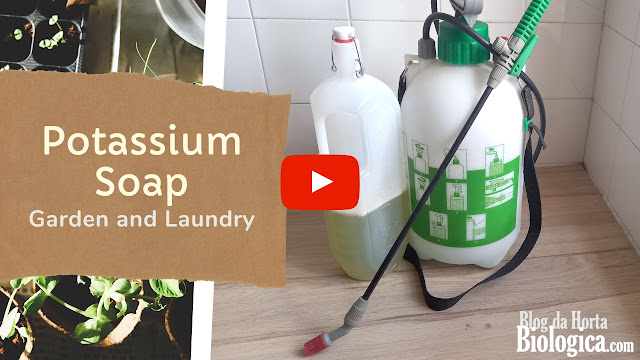
The use of this detergent is the same as for conventional detergents, meaning the recommended doses should be used according to the hardness of the water.


Dilution For Garden Pests


The 171g we saved for later were diluted to spray the pests in the vegetable garden and orchard. 

The dilution ratio for spraying varies depending on the type of soap, the pests to be combated and how heavily the plants are infested. In order to obtain a mild spraying liquid, for lightly infested plants, we will use a maximum of 10L of water for dilution. The 10L makes this easier as we have a 10L pot or two 5L water bottles can be used as an alternative. 

Many sprayers for home gardens are also 5L, so we advise you to make the dilutions according to these proportions, only adjusting the amount of soap according to the severity of the pest attack in the garden.

As this soap is difficult to break down, we recommend starting the dilution in the same way as we did for the laundry detergent, i.e. pour boiling water into the pan in a ratio of 1:1.5, break down and dissolve the soap, and then pour the solution into the pan or divide it between two bottles, filling them to the top with water. That's how you get a soapy spray!


How to Apply in the Garden and Orchard


Transfer the liquid to a sprayer.

The spray should only be used if pests are observed. It should not be used merely as a preventative method.

It should be applied directly to soft-bodied insects such as aphids, lice, mealybugs, caterpillars, whiteflies and moths. Remember not to spray directly on beneficial insects such as ladybugs and bees.

It can be applied once or twice a week, early in the morning or late in the day. Apply to the stems and leaves, not forgetting the back of the leaves where there is a higher concentration of pests.

Avoid applying on windy days and during the hottest hours of the day.


This post is already lengthy, and we hope it has been helpful to our readers! For a better understanding of this entire process, watch our video now, where we show each step in detail.

A big hug to our readers who follow us in the Azores and around the world!


Natural Plant Fertilizer | 3 Ingredients | 7 Ways To Use

Today we are going to share a homemade, natural recipe for fertilizing plants. With 3 ingredients only, which can be used individually or together, this is a very complete recipe to provide optimal growing conditions in a balanced, nutrient-rich soil. 

These tips and recipes are also in our book: The 5 C's of Aromatic and Medicinal Plants - Cultivate, Care, Collect, Conserve and Consume - 30 Plants and Their Properties. At the end of this post, you can also watch our educational video where we show, in detail, all the ways to use them.


This homemade fertilizer is very simple and inexpensive, consisting of ingredients as simple as eggshells, banana peels, and coffee grounds. These ingredients that you already have in your kitchen will do wonders for your plants! Let's see why we should use them.


Why These Ingredients?

Plants mainly need nitrogen (N), phosphorus (P), and potassium (K) for a balanced and healthy development. Eggs, bananas, and coffee provide each of these nutrients.

  • Eggshells are rich in calcium (Ca), magnesium (Mg), and potassium (K), which enrich the soil and contribute to optimal plant growth. Eggshells are also used to correct the most acidic soils.

  • Banana peels are an excellent source of potassium (K) and phosphorus (P), also providing calcium (Ca) and magnesium (Mg) to plants.

  • Coffee grounds have all 3 main ingredients, nitrogen (N), phosphorus (P), and potassium (K). Because of their acidity, they can also be used to correct more alkaline soils.


Ways to Use


There are many simple ways to use these ingredients, which makes them excellent allies in plant care, especially when you are have little time. Let's look at the various ways to use these ingredients, individually or together.


Using the Ingredients Individually


#1 Using the Whole Eggshells

Ideally, you should break the shells into small pieces with your hands and mix them with the soil. When left on the surface, they are also an excellent trap for slugs and snails.


#2 Using Powdered Eggshells

When crushed and reduced to powder, they are more easily absorbed by the soil. Grind with a coffee grinder and sieve. For this task we recommend wearing a mask so as not to inhale the powder


#3 Banana Peels Cut Into Pieces

Instead of discarding banana peels or putting them in the compost pile, they can be cut into small pieces and mixed with the soil near the base of the plants.


#4 Banana Peel Decoction

An decoction of banana peel is used to spray or water plants.

  1. Separate peels of 2 large bananas into 1L of water.
  2. Boil for 5 minutes.
  3. Allow to cool and strain.

    As it is a concentrated liquid it must be diluted in water.
  • To spray: 1 cup of decoction to 4 cups of water.
  • For watering: 1 cup of decoction to 2 cups of water.

Apply this fertilizer every two weeks.


#5 Coffee Grounds at the Base of the Plants

Apply some coffee grounds around the base of the plant and mix with the soil for a better result.


Using the Ingredients Together


#6 Eggshells + Coffee grounds

The mixture of eggshells and coffee grounds contributes to a balanced soil.


#7 Eggshells + Banana peels + Coffee grounds

The mixture of the 3 ingredients: eggshells, banana peels, and coffee grounds constitutes a very complete and effective natural fertilizer for plant growth.

  1. Select 3 equal parts of each ingredient (one cup of each, for example). 
  2. Place in the food processor and grind. 
  3. Add water as needed to obtain a creamy texture.
  4. Apply around the base of the plants once every two weeks.

These natural fertilizers can be used on both small plants and trees. Because they are so simple and do not have unpleasant smells, you can make them even if you live in an apartment and have the plants in the kitchen.

We hope you have enjoyed all the tips. Take a look now at our educational video. If you haven't subscribed to our YouTube channel yet, take the opportunity to do so if you don't want to miss a thing!

Xo Xo


How To Grow Roses From Stem Cuttings | Propagation After Pruning

Roses can be grown in pots or in situ, and even people who live in apartments can have their own as well. Whether for medicinal use or just for decoration, roses are well worth having!

Although roses also have their seeds, they are most easily propagated by cuttings and that's just what we're going to look at in this post. Also check out our educational video where we show how to propagate roses from cuttings step by step.


We did this propagation after pruning our rose bush which was already very big.  You can learn more in our post When, How and Why To Prune Roses. It was after this pruning that we used the cuttings to have more roses without having to buy them. The method is quite simple and we are going to share it below.

Here is how we propagate our roses:


Separate The Stems By Size


After pruning, we start by organizing and putting together the stems of similar size. For us it is easiest to separate into 3 sizes: small, medium and large. Stems that are too large can also be cut off, thus obtaining more cuttings for planting.

This task will allow you to better organize the space where each cutting will be cultivated.


Define The Growing Space For Each Cutting


Small and medium-sized stems can be placed in appropriately sized pots.

Large and vigorous stems can be cultivated in situ.


Planting In a Pot


  1. Place some expanded clay in the bottom of the pot.
  2. Add good quality soil. It can be garden soil.
  3. Before you bury the stem, remove the thorns from the lower part and, with a knife or razor, scrape off the surface layer that protects the stem. This will facilitate the appearance of new roots.
  4. Bury the lower part of the stem, tucking it in and smoothing it with soil so that the plant has a stable base.
  5. Give a good watering.
  6. The pots should be kept in a place sheltered from frost and the plants should be watered every day, if possible twice a day.


Planting In Situ


Planting the large stems is similar.

  1. Before burying the stem, remove the thorns from the lower part and, with a knife or razor, scrape off the surface layer to promote the development of new roots.
  2. Dig a hole in the ground, preferably in a place where there is no frost. If the soil is not rich in nutrients, put some compost in it.
  3. Bury the bottom part of the stem, tucking it in and smoothing it with soil so that the plant has a stable base.
  4. Give it a good watering. The plants should be watered every day, if possible twice a day.
  5. When growing in situ, the distance between plants should be at least 1,20m.


What To Do With The Leftover Stems?


If there are any leftover stems, they can be placed in the compost pile.

If the leftover stems are able to regrow and sprout, they can be given to neighbors, friends, or family members who want to have a rose bush.


How To Know If The Cultivation Has Worked?


After a week or two, the shoots may already be growing, thus indicating that propagation was a success.

If the cuttings do not give new shoots by the spring, it is likely that they have not rooted. You must keep in mind that not all cuttings will take root, but this is no reason to be discouraged. Roses grow a lot and propagation can continue after pruning the following year.

Happy growing!


VIDEO - How To Grow Roses From Stem Cuttings | Propagation After Pruning


When, Why and How To Prune Roses

Roses are beautiful plants that can be found in gardens, both public and private, all over the world. The medicinal properties of roses have been known since ancient times and these flowers are one of the most versatile in personal care. If you are interested in learning more about the properties and uses of roses, read our post Rose Water: Benefits and How To Make It

In this post we're going to dedicate to rose care. We'll look at when, how, and why to prune these plants. At the end of the post, also watch our educational video where we show how to prune roses step by step.


When to Prune Roses?


To know when to prune rose roses, the following factors must be taken into account:


The Type of Rose


There are several types of roses, each with different needs. The best time to prune depends on the type of rose and its environment. Therefore, it is necessary to know the cultivated varieties so that the treatments are the most appropriate.


Some examples are remontant roses that bloom several times a year and should be pruned at the end of winter, and non-remontat roses that only bloom once a year and should be pruned soon after blooming.


The Best Pruning Season for the Type of Rose


  • It should also be noted that if pruning is made early, the roses will bloom earlier and the buds may be frost-burned. If pruning is made late, the plant may be damaged by the loss of sap after the cuts.

  • The rose bush we pruned for this post and video is a remontant rose bush, and for these roses, the best time to prune is during their short dormant period, near the end of winter, when temperatures begin to rise and there is less likelihood of frost.

  • It should also be kept in mind that during the waning quarter, there is low sap flow, so the plant is less likely to lose sap after cutting.

  • Pruning should be avoided on rainy days, as well as in the early morning hours before the dew has dissipated, in order to avoid water accumulation in the cuts, which could cause the appearance of fungi.


What to Use for Cutting?


When pruning rose bushes, depending on the thickness and height of the branches, the following tools will be needed:


  • Pruning shears
  • Branch cutter


Other Important Materials


  • Gardening gloves
  • Long-sleeved shirt
  • Ethyl alcohol and a cloth for disinfecting the material


Pruning material should always be well sharpened and disinfected before use on each plant, in order to prevent a sick plant from passing diseases and pests on to other healthy plants.


What to Cut?


The first thing to do before start pruning is to examine the plant in order to identify:


  • Branches that grow towards the center of the rose bush
  • Crossing branches
  • Dry, damaged or diseased branches
  • Branches that are too long or too high
  • Branches growing towards passageways


Why To Cut?


Roses should be pruned for several reasons:


  • To give the plant a harmonious and careful shape
  • To prevent excessive development
  • To favor the aeration and lightening
  • To promote the growth of new and more productive branches
  • To do a general cleaning of the plant, removing unnecessary branches


Let's see why to prune each of the branches we mentioned above:


Branches that grow towards the center of the rose bush need to be cut back so that the plant doesn't become too dense. Excess branches make all the branches overall weaker. By choosing the best ones and cutting the weakest ones, the branches will become stronger and more productive. On the other hand, you also create more space for better air circulation, for sunlight to reach all the branches, and for easier access to the interior of the plant when pruning or spraying against any pests and diseases is needed. Cutting back branches that grow inward also allows you to define and balance the shape of the plant.


Crossing branches compete with each other and harm both each other's growth and productivity. You should cut those that are growing towards the center of the rose bush and favor those that are growing outwards, as they will contribute to the formation of the plant and have better sun exposure.


Dry, damaged or diseased branches are also useless. Damaged branches can be a gateway for pests and diseases, so they should be cut off immediately.


Branches that are too long or too tall become weaker and are at risk of breaking, plus it is not practical to have a rose bush that is too tall. Cutting these branches makes them stronger while allowing you to define the contours of the plant.


Branches that grow towards passageways take up unnecessary space and can even injure people passing by, so they should be cut back in a way that they don't grow back in the same direction.


How to Cut?


You can can a whole branch or not, depending on the shape that you want to give to the plant.


If the goal is to eliminate an entire branch, the cut should be made where the branch begins, that is, at the insertion with another branch or with the trunk of the rose bush. This is a swollen area (also known as the branch neck) and is an area favorable for healing. If cut correctly and the branch neck is left intact the wound will seal more easily, which is also crucial for protecting the plant from pests and diseases.


If the goal is to shorten a branch, the cut should be made above the bud so that it can sprout and grow healthy and vigorous.


The ideal cut should be precise and made all at once, whenever possible with a slope of about 45 degrees, which prevents the accumulation of water that can cause the branch to rot and fungi to appear.


Although roses are pest resistant, after pruning you can also apply a sealing paste to the cuts so that they heal more quickly and are not exposed to the elements that can lead to disease. The paste should be applied over and around the cut to cover the entire area of the cut.


Take a look at our video where we show how we pruned our rose bush.


VIDEO - When, Why and How To Prune Roses