" Blog da Horta Biológica: Natural Products
Mostrar mensagens com a etiqueta Natural Products. Mostrar todas as mensagens

Potassium Hydroxide Liquid Soap for Garden Pests and Laundry

At the request of our Azorean readers, we're going to teach how to make potassium hydroxide / coconut soap for garden and orchard pests... and more!

First of all, we'd like to thank our readers for following us and trusting in our work, and we'd like to send a big hug to those of you who follow us from the wonderful islands of the Azores!

At the end of this post, you can also watch our educational video where we show you in detail how to make this soap.


For this post, we've formulated a soap that, in addition to having only only a few ingredients, is very effective at fighting pests in the garden and orchard, as well as washing clothes in the home laundry.

Let's start by looking at the ingredients and understanding why each one is used.


Ingredients


  • 141g Cold-pressed extra virgin coconut oil
  • 94g Extra virgin olive oil
  • 60,11g Potassium hydroxide (KOH), 90% pure *
  • 180,32g Distilled water


* Potassium hydroxide is highly hygroscopic, which means it has a strong ability to absorb moisture from the air. For this reason, as soon as it is weighed, it should be immediately sealed in its container, which must be well stored to prevent its deterioration. After sealing the bottle, we place it inside a tightly closed bag and store it in a cabinet to avoid contact with moisture. See the images in the video for a better understanding.


If you don't have a precision scale, round down, never round up.


Important: This soap does not have super fat, so it is not intended for use on the skin!


Why These Ingredients


First of all, it's important to remember that all the ingredients must be of high quality! Sometimes, when the soap is not made for skin use but for pests and laundry, there is a temptation to use low-quality oils. In this case, we strongly advise against it, since the purpose of this soap is also to nourish and care for the plants. 

On the other hand, we also want to stress that this formula has been calculated on the basis of pure oils. Each oil has its own saponification index, which means that if dubious oils are used (i.e. oils that are not truly extra virgin), the result could be a fiasco.

If you've never made soap before and aren't familiar with the process or the technical terms we are using, please read our post first: How To Make Soap.


Let's take a look at each of the ingredients:


  • Cold-pressed extra virgin coconut oil: coconut soap is extremely effective in controlling garden pests (find out more in our post Soap and Vegetable Oil Spray). Additionally, coconut is highly nutritious and is used as an organic fertilizer for the healthy growth and development of plants.
  • Extra virgin olive oil: the oil can be plain or macerated with pest-repellent plants such as peppermint, rosemary, thyme, etc. Find out more about macerations in our post How To Make a Maceration and more about plants and their uses in our book The 5 C's of Aromatic and Medicinal Plants. The use of olive oil in this formula has two functions. One is to add more beneficial properties to the soap, and the other is to achieve a final consistency that is easier to work with, since 100% coconut soap is much thicker and more difficult to break down and dilute.
  • Potassium hydroxide (KOH) 90% pure: potassium is one of the essential nutrients for plants, and potassium soap, in addition to helping control pests, will contribute to plant protection, nutrition and growth. It has to be 90% pure to guarantee effectiveness in the saponification reaction. 

  • Distilled water or rainwater: is used because it is free of impurities, minerals, and contaminants. Distilled water must be used to ensure that the chemical reactions take place as expected and to guarantee the purity, precision and consistency of the final product.


The Materials


To make this soap, you need to gather some materials. The ones we've marked in blue must be used exclusively for making soap because, for food safety reasons, the same materials cannot be used for cooking food and making soap (due to the chemical reactions between fats and potassium hydroxide, also known as caustic potash). 


None of the materials can be made of aluminum because of the reaction with potassium hydroxide!


This list of materials is in the order of use when making soap. 


  • 1 Digital kitchen scale (must be digital for greater accuracy in weighing ingredients)
  • 1 Stainless steel pan
  • 2 bowls for weighing the oils (we recommend weighing them separately in case of mistakes that require adjusting the quantities)
  • 2 tablespoons to help remove the coconut oil from the jar if it is solid
  • 1 Plastic or glass container for the water
  • 1 Plastic or glass container for the potassium hydroxide
  • 1 Pan base
  • 1 Stainless steel spoon to dissolve the hydroxide in the water
  • 1 Kitchen spatula for scraping the bowls with the oils
  • 1 Spatula for stirring the potassium hydroxide solution with the oils
  • 1 Hand blender (yes, it really must be exclusive for soap making!)
  • 1 Digital kitchen thermometer
  • 1 Small spoon (to help with pH tests)
  • 1 Pyrex
  • pH strips
  • 1 Large spoon (to help transfer the soap to a container)
  • 1 Container with lid to store the soap batter at the end
  • 1 Water container
  • 1 Water boiler, which will be very useful for dilution
  • 1 Funnel
  • 1 Container to store the liquid soap in at the end

These are the materials we use. Some of these materials are mandatory, others can be adapted according to what you have at home. Watch our video for a better understanding.


Safety Equipment


As always, safety equipment is more than mandatory, and here are all the necessary elements:

  • Safety goggles
  • Rubber gloves
  • Face mask. Surgical masks (also known as “Covid masks”) are not effective for dealing with chemical reactions, so more closed masks should be used.
  • A long-sleeved lab coat and closed shoes. All skin must be well protected.
See all the safety warnings on soap making in our post How To Make Soap.


How to Make Potassium Hydroxide Liquid Soap


First of all, you should know that the result is never liquid soap, but a thick batter that only becomes gel-like or even liquid once diluted, depending on the dilution ratio.

This soap is made using the Hot Process, meaning the soap will be cooked and will not need to cure once it has been made. Once again, if you don't understand these terms, read our post first: How To Make Soap.


Before we start the step-by-step instructions, we strongly recommend that you have a log book every time you make your own soap, so that you can write down (and later remember) all the important details of each production batch. Here is the notebook we use and recommend to everyone who makes soap at home, whether for personal use, to give away or to sell:


Log book that we use and recommend


So now we're going to share with you how we make this soap at home. Here are all the details:

  1. Start by weighing the empty stainless steel pan (ours weighs 374g). Knowing the weight of the pan will be crucial at the end of the whole process.
  2. Weigh the oils separately, each in its own bowl.
  3. Weigh the water.
  4. Put on all the safety equipment before starting to handle the potassium hydroxide.
  5. Weigh the potassium hydroxide.
  6. Add the oils to the pan (use the kitchen spatula to remove all the oil from the bowls, ensuring there is no waste or significant differences in the amount of oil).
  7. Turn the stove to low heat. (There's no need to heat it up too much, just until the coconut oil melts completely).
  8. While the fats are heating, pour the hydroxide into the water (never the other way around!) and stir with a stainless steel spoon.
  9. Once dissolved, add the water solution to the fats in the pan;

From here on, it's crucial to constantly monitor the temperature while stirring the solution!

    10. Measure the temperature and stir the solution with the spatula that is exclusively for soap making. The temperature of the solution should not exceed 70ºC. For those who have a Crockpot (a pan that maintains the temperature), this won't be a problem, but for those who don't, as in our case, it's necessary to keep putting the pan on and off the heat to make sure it doesn't go over 70ºC.
     11. After stirring the solution a little with the spatula, use the hand blender. Blend the solution for a few minutes, always monitoring the temperature, in a combination of stirring and a little heat from the stove.
     12. When the batter is too thick for the hand blender, use the spatula again. For us, the batter took 8 minutes to reach this point.
       13. When the batter has thickened and is beginning to steam a little, turn off the stove and continue cooking the batter using only the residual heat from the pan.
       14. Once the batter has reached the consistency of a paste where it resembles mashed potatoes, but much thicker, it is probably ready. For this we do the pH test.
      15. To do the pH test, put water in a Pyrex, add just a small amount of the soap paste (for a more reliable result, take it from the inside of the paste and not the outside) and stir well. Then, add a little boiling water as this helps to dissolve the soap paste.
        16. Place a pH strip in the water and check the result. The ideal pH for soap is between 8 and 10. Our paste has a pH of 8, which means that the paste is cooked and the soap is ready.
         17. Allow to cool completely before moving on to the next stage.


Storage and Dilution


To store and dilute, it requires a bit of mathematics, but nothing too complicated.

We got a total weight of paste of 429g. How do we know this? We know because we weighed the tare of the pot at the beginning (374g) and weighed the pot again after the soap paste had cooled (803g).  803-374 = 429g of paste.

For this post and video, we decided to divide the paste in half so that we could demonstrate how to store it and how to dilute it, both for use against garden pests and for home laundry. Let's break it down:

  1. Once the paste has cooled down, we removed about half of it from the pot using a spoon and a spatula.
  2. After this removal, the pan weighed 632g. So, 632 - 374 = 258g. This was the amount that remained in the pan to be diluted.
  3. 429 - 258 = 171g. This was the amount we stored for later dilution.


Storage

The 171g for further dilution has been stored in a plastic container with a lid. It can be stored in a cool place at room temperature.


Laundry Dilution


The 258g that remained in the pot were diluted to make laundry detergent. 

Now, how to dilute it?

The ideal ratio for this is 1:1.5

So 1 part soap to 1.5 parts water (258g x 1.5 = 387g water).


  1. Weigh out 387g of water.
  2. Use a kettle to quickly bring the water to a boil. The hot water will help break down and dissolve the thick paste. Some water is always lost to evaporation when boiling, but for this purpose, it doesn't make much difference.
  3. Add the boiling water to the pan, use the spatula to break up the paste a little, distributing it better throughout the water. Let it sit for a few minutes.
  4. Use the hand blender until it becomes a homogeneous liquid.
  5. Essential oils can be added at this stage. We prefer to use neutral detergent.
  6. Leave it to cool completely.
  7. After it has cooled, use a funnel to pour it into a container suitable for use in the laundry.
The use of this detergent is the same as for conventional detergents, meaning the recommended doses should be used according to the hardness of the water.


Dilution For Garden Pests


The 171g we saved for later were diluted to spray the pests in the vegetable garden and orchard. 

The dilution ratio for spraying varies depending on the type of soap, the pests to be combated and how heavily the plants are infested. In order to obtain a mild spraying liquid, for lightly infested plants, we will use a maximum of 10L of water for dilution. The 10L makes this easier as we have a 10L pot or two 5L water bottles can be used as an alternative. 

Many sprayers for home gardens are also 5L, so we advise you to make the dilutions according to these proportions, only adjusting the amount of soap according to the severity of the pest attack in the garden.

As this soap is difficult to break down, we recommend starting the dilution in the same way as we did for the laundry detergent, i.e. pour boiling water into the pan in a ratio of 1:1.5, break down and dissolve the soap, and then pour the solution into the pan or divide it between two bottles, filling them to the top with water. That's how you get a soapy spray!


How to Apply in the Garden and Orchard


Transfer the liquid to a sprayer.

The spray should only be used if pests are observed. It should not be used merely as a preventative method.

It should be applied directly to soft-bodied insects such as aphids, lice, mealybugs, caterpillars, whiteflies and moths. Remember not to spray directly on beneficial insects such as ladybugs and bees.

It can be applied once or twice a week, early in the morning or late in the day. Apply to the stems and leaves, not forgetting the back of the leaves where there is a higher concentration of pests.

Avoid applying on windy days and during the hottest hours of the day.


This post is already lengthy, and we hope it has been helpful to our readers! For a better understanding of this entire process, watch our video now, where we show each step in detail.

A big hug to our readers who follow us in the Azores and around the world!


Natural Syrup with Herbs, Lemon, and Honey | For Dry Cough and Flu Symptoms

At home we like to grow plants and to make the most out of them. That's why we use them far beyond food. Plants are also wonderful for improving physical and emotional well-being. So today we are going to share one more tip. We will show you how we make natural syrup with herbs, lemon, and honey. All the ingredients we use are from our production, organic, in their purest state, and are all suitable for flu. At the end of the post you can also watch our educational video, where we show you everything step by step.


This syrup is indicated to relieve cough, sputum, and throat inflammation. In creating our own natural syrup recipe, we took into account the ingredients we had available at the time and the healing and medicinal properties of each one. So let's start by getting to know the ingredients:


Ingredients


  • Water - 200ml / 6.76oz
  • Herbs (Oregano and Thyme) - 25g / 0.88oz leaves. (The leaves should be removed from the stems so they are in full contact with the water during decoction and maceration).
  • Lemon - 50ml / 1.69oz squeezed lemon juice. The number of lemons needed to obtain 50ml of juice is variable, depending on the size of the lemons and the amount of juice and pulp present in each one.
  • Raw Honey - 150g / 5.29oz. It is important that the honey is multifloral and does not have a strong aftertaste, otherwise the syrup may become undrinkable.


For this recipe we harvested oregano and thyme that grow spontaneously in our garden. However, they are also easy to grow in a pot. Thyme is particularly interesting to grow, as it is a plant that is available all year round. See this post on how to grow thyme.

The lemons were harvested directly from tree to kitchen. If you have a terrace or a nice balcony, you can also plant a lemon tree and harvest lemons several times a year.

The raw honey is from our production (a big thank you to our bees!). Raw honey is honey just as it is extracted from the beehives, without additives or dubious mixtures. You can see how we produce honey in this post.


Why These Ingredients


Oregano: Besides being an excellent source of vitamins and minerals, it has expectorant action, and it is anti-inflammatory, antioxidant, and antimicrobial. 


Thyme: Like oregano, thyme is also an excellent source of nutrients, and it is expectorant, anti-inflammatory, digestive, antioxidant, and antiseptic. 


Lemon: Rich in vitamin C, it is also antioxidant, digestive, and hydrating. Lemon is one of the anti-inflammatory foods and strengthens the immune system.


Honey: Relieves cough and sore throat. It has soothing, antioxidant, antimicrobial, and  healing properties. It is an excellent food in strengthening the immune system.


Want to know more about growing and using medicinal herbs at home? You might like to read our book: "The 5 C's of Aromatic and Medicinal Plants - Cultivate, Care, Collect, Conserve and Consume - 30 Plants and Their Properties". Learn more at the link below.


Method

  1. After harvesting the herbs, remove the leaves from the stems until you have 25g of plant.
  2. Place the leaves in 200ml of water and bring to a boil. The goal is to make a decoction with a maximum boil of 5 minutes.
  3. After the decoction, remove from the heat and leave the pot covered with the plant to macerate in the water for 24 hours.
  4. Strain the water so that it is completely free of plant remains (place the plant remains in the compost bin).
  5. From the remaining water, use 50ml.
  6. Make lemon juice and strain it to obtain only the juice, discarding the pulp (put the pulp in the compost bin).
  7. Weigh out 150g of honey.
  8. Place the 3 ingredients in a pot over low heat until the honey is diluted. Do not let it boil! The goal is only to dilute the honey so that the ingredients mix together. The ingredients can be put directly into the pot, but we prefer to use a double boiler. This helps the honey not to heat up as much or as quickly, which also helps preserve its properties.
  9. Once the liquid is uniform, turn off the stove and remove from the heat.
  10. Let it cool a little and pour the syrup into a previously sterilized glass jar.
The liquid will be slightly thick just as a conventional syrup.
    This recipe yields about 270ml of syrup. The final yield, depends on the thickness of the honey.


    Some Extra Tips

    Each person has their own taste and this recipe is just our suggestion. So after you taste it for the first time, and if you want to adjust the recipe to your taste, here are some tips:

    • For a more aromatic syrup, increase the amount of herbs a little bit while keeping the same amount of water. 
    • For a less acidic syrup, decrease the amount of lemon juice. The acidity of the lemon is always variable and we chose this amount according to the acidity of the lemons on our lemon tree.
    • The thickness of the final liquid will depend a lot on the thickness of the honey. We do not advise, however, to add much more honey. Instead of increasing the amount of honey, you can decrease the amount of lemon juice, for example. We also emphasize again the importance of choosing a honey with a mild flavor.


    Intake

    • We advise letting it cool completely before intaking.
    • Take this syrup when you have the usual cold and flu symptoms. 2 - 3 tablespoons of syrup per day. 
    • Shake the jar before each use.

    Warning: this syrup is very tasty and can make you want to take it...very often! So you have to be careful not to intake too much, especially if you are diabetic!


    How To Store

    Although it is not necessary to store in the cold, the jar can be placed in the refrigerator to make it last longer and keep the liquid thicker.

    If stored at room temperature it can last about 4 weeks.

    If stored in the refrigerator it can last about 6 weeks.


    Natural Medicine vs Conventional Medicine

    While natural medicines are often effective and sufficient for a cure, you must remember that each case is unique and what works well for some people may not work for others.

    As always, it is important to remember that natural medicine may not be sufficient to replace conventional medicine when the latter is really needed. If flu symptoms are persistent, it is advisable to consult a doctor or pharmacist.


    VIDEO - Natural Syrup with Herbs, Lemon, and Honey | For Dry Cough and Flu Symptoms


    Cataplasm / Poultice: What Is It? How To Do It? How To Use It?

    Cataplasm or Poultice is a paste of medicinal herbs that is applied to the skin to soothe burns, inflammation, irritated skin, or improve blood circulation. It is a natural remedy for external use, and as far back as ancient times the Romans and Greeks used it to treat various ailments.

    We are at the peak of spring, a time when there is an abundance of plants, and it is just the right time to bring you another tip for more natural self-care. In this post we will show you how to make a cataplasm/poultice with fresh and dried plants, how to choose the plants and how to apply it to the skin. At the end of the post, also watch our educational video where we show everything, step by step.


    What is a Cataplasm/Poultice?

    A cataplasm or poultice is a paste made from medicinal herbs macerated and mixed with water and clay. The herbs used can be fresh or dried, and the use of clay, although optional, is well advised because clay, in addition to its skin healing properties, also helps form a consistent paste that becomes easier to apply.


    How to Choose the Plants?

    You can use a single plant or a mixture of several plants. The plants should be selected according to the problem to be treated. Here are some brief examples of plants that can be used individually or in a combination: 


    For relieving muscle pain - Mint, Passion flower, Rosemary, Sage, and Nasturtium

    For skin care - Calendula, Lavender, Chamomile, Parsley, and Rose

    For menstrual pain relief - Anise and Sage

    To bring down fever - Lime, Lemon grass and Laurel


    These are just a few suggestions and we remind you that the plants and their active ingredients may have different effects on each person. If you have adverse reactions to any plant, its use should be discontinued. We also remind you that, unfortunately, natural remedies are not a substitute for conventional medicine when it is really needed.


    Learn more about medicinal plants and how to prepare and use them in our book: "The 5C's of Aromatic and Medicinal Plants - Cultivate, Care, Collect, Conserve and Consume 30 Plants and Their Properties".


    How To Do It?


    Let's see how to make this medicinal paste with fresh herbs and with dried herbs:


    With Fresh Herbs

    1. Choose the plants according to the problem to be treated. There are no right amount. An amount proportional to the size of the area to be treated should be chosen.
    2. In a bowl, macerate the plants. Now, when we say macerate, we mean to start by crushing the plant with a pestle so that it will then more easily release its active ingredients pnto the skin.
    3. Add just a little hot water to help soften the plants and continue macerating.
    4. Optionally, add a little clay* to help form a paste-like consistency. When it forms a homogeneous paste, the cataplasm/poultice is ready to apply.

    * To make the cataplasm/poultice in this post and video, we used green clay. If you have very sensitive skin you can use white clay as an alternative.


    If there is a good amount of plant left over, you can make bundles and dry them for later use, or you can use them to make smudge sticks.


    With Dried Herbs

    With dried herbs the process is similar. Only the amounts of water and clay may vary, since the plants are dry.

    1. Choose the plants according to the problem to be treated.
    2. In a bowl, macerate the plants.
    3. Add a little hot water to help soften the plants and continue macerating.
    4. Optionally, add a little clay to help form a paste consistency. When it forms a homogeneous paste, it is ready to apply.

    The plant left overs can be placed in the compost pile.


    How To Use It?

    The cataplasm/poultice can be applied cold or hot, depending on the therapeutic purpose. If it is to relieve muscle pain, we advise applying hot. If it is to soothe skin burns, apply cold.

    Apply the paste to the affected area and cover with a gauze, bandage, or cotton cloth to ensure contact with the skin. Some people just apply the paste to the skin without bandaging. However, we recommend using bandages, as they help keep the paste in place, especially if applied to an area where it is liable to run off. 

    Leave it on for 10 minutes to 1 hour to enjoy all its emollient, anti-inflammatory, and soothing effects.


    What About After Use?

    After use, the paste should be placed in the compost pile, as it is all-natural. If the gauze or bandage is 100% natural, it can be placed in the compost pile as well. If a cotton cloth is used, it can be washed and reused.


    We hope you enjoyed today's tips, and don't forget to check out our YouTube video to see, in a practical way, how to make these medicinal pastes. If you haven't subscribed to our channel yet, take the opportunity to do so if you don't want to miss a thing!


    VIDEO - Cataplasm / Poultice: What Is It? How To Do It? How To Use It?


    How To Make Beeswax Candles at Home | Step-by-Step Tutorial For Beginners

    Beeswax is one of the most beautiful things Nature can give! Everything bees produce is absolutely wonderful and so beneficial to use! We have already shown here on the blog How To Clean Beeswax, how to make Beeswax Pellets and even how to use beeswax in various natural cosmetics, such as Moisturizing Cream or Lip Balm, among others. In this post we will show you how to make beeswax candles to set the mood at home. At the end of the post, you can also watch our educational video where we show you everything in detail. 


    Making beeswax candles at home is a simple process, but it requires some care. So let's look at everything that is needed and get to know several tips and important advice for a good result.


    Choosing The Container


    Choose a
    heat-resistant container. 

    The choice of container's shape is also very important. 

    Some bad examples are containers that are too deep and have a narrow opening. If they are too deep, the wick will have to be very long, and if the opening is narrow, the wick will have less oxygen to burn freely and may also burn the edges of the container. 

    Some good examples are glass cups or wide-mouthed jars that are not too large.  Metal cans or silicone molds can also be used to make candles. However, glass jars will always be the cheapest and easiest option to find.


    Choosing The Wick


    Choose a wick 
    of adequate thickness for the mouth of the jar. 

    For a wide jar you should use a thick wick, for a small jar, a thin wick. 

    If the wick is too thin, it will not be able to melt the wax to the edges of the jar. 

    If the wick is too thick for a small jar, it is very likely that the wax may crack in the middle.

    The ideal is to choose the jar first and then buy the wick according to the size of the jar. 


    Gathering All The Materials


    Now that we have seen how to choose the container and the wick, let's gather all the materials:

    • 1 Sterilized container.
    • 1 Wick.
    • 1 Wick Holder. Alternatively 2 coffee sticks or 1 clothespin can be used.
    • 1 Pyrex. Ideally a measuring cup that can easily pour liquids.
    • 1 Pan with water up to 2 inches high.
    • 1 Pan base.
    • 1 Digital kitchen thermometer.
    • Beeswax bars or pellets, as needed. The amount of beeswax will depend on the size of the jar. We recommend using beeswax pellets, as it makes it much easier when weighing.
    • 1 Small container for the beeswax.
    • 1 Kitchen scale.
    • 1 Kitchen glove.
    • EO (essential oil) of choice, as needed. A fragrance can also be used, but it you must remember that fragrances are synthetic and can cause allergies in more susceptible people. Therefore, we recommend the use of EO. You can use just one oil or a synergy (blend) of oils of your choice. A good quality EO must also be used, otherwise the candle will be unscented.
    • 1 Small container for the EO.
    • 1 Cloth.
    • 1 Ice cream or coffee stick for mixing the wax and essential oil. If you want to use a spoon, it might be a good idea to keep it exclusively for this purpose, because the wax gets very sticky and is very difficult to remove.
    • Scissors to cut the wick at the end.

    The candle we made for this post and video took 40g (1,41oz) of beeswax pellets and 2,4g/ml (0,08oz) of lavender essential oil. Follow the instructions to make a candle to suit the size of the jar you have available.


    Method


    1 - If have no experience in dealing with beeswax, it may be a good idea to protect the work area with parchment paper or silicone sheets. Once cold, beeswax, becomes very hard and sticks to surfaces.


    2 - Fill the chosen jar with beeswax pellets. Set the pellets aside and fill the jar again. Thus, you will use double the amount of wax that fits inside the jar in solid state. This is because, once melted, the wax will spread better throughout the jar, and some of the wax will always be retained in the Pyrex. We recommend weighing the total amount of wax on a scale, in case more candles are going to be made in the same type of jar.


    3 - After you know the weight of the wax, weigh out a maximum of 6% of essential oil for the total weight of the wax. For example: if you have 100g (3,52oz) of wax, add a maximum of 6g (0,21oz) of essential oil. The density of oils is variable, but the weight in ml will be very similar, so 6ml of essential oil can be added.


    4 - Cover the EO container with a cloth. EO is volatile, so it should remain covered until poured into the wax.


    5 - Place the beeswax inside a Pyrex. 


    6 - Place a Pyrex in a pan with water up to 2 inches high.


    7 - Turn on the stove on low heat and let the wax melt. The melting point of beeswax is at 70ºC (158ºF) but, if the amount is large, it may need more temperature to melt.


    8 - After melting completely, remove the wax from the heat and place the Pyrex on top of a pan base, so that it doesn't come into contact with a cold surface, which would cause the wax to solidify too quickly.


    9 - Check the temperature with a digital kitchen thermometer.


    10 - Before the temperature drops below 70°C, add the EO and mix well. This step is very important. The EO cannot be added when the wax is too cold, as it will not blend well. Below 70ºC the wax begins to thicken and it becomes impractical to mix with the EO and to pour into the jar. It also cannot be added when the wax is too hot, as the heat of the wax will cause the scent to dissipate and the candle to become less fragrant;


    Extra Tips:

    Ideal temperature to add the EO: 71 - 73°C (159 - 163ºF)

    Ideal temperature for pouring the wax into the jar: 65 - 71º C (149 - 159ºF)

    The room temperature has a lot of influence on the preparation of beeswax candles. The colder the air is, the faster the wax will thicken. It is therefore necessary to measure the wax temperature several times and to work quickly so that it does not have to be melted again (which could further dissipate/diminish the aroma of the candle).


    11 - Carefully and consistently pour the wax into the jar. Neither too fast, nor too slow, so that the wax look homogeneous, without bubbles or visible layers. 


    12 - Let the wax cool completely. The time it takes will depend on the air temperature. It may take a few hours to solidify completely. Alternatively, the jar can be placed in the refrigerator when the wax is already slightly solid. When placed in the cold, the candle can be fully solid after 1 hour.


    13 - After the wax is completely solidified, cut the wick at about 1cm (0,39") from the top of the wax.


    14 - The candle is ready to use!


    The candle we made for this post and video was made with beeswax from our beehives. It is a pure wax that tends to darken over time.

    Store-bought beeswax tends to be very yellow or white because it has been subjected to industrial processes.


    Material Cleaning


    The wax that is left in the Pyrex can be removed with a spoon or can be melted again in a water bath and used to make more candles. 

    Do not pour the wax down the drain of the basin because the accumulation of wax can clog the pipes.

    Do not wash the materials in the dishwasher, as wax residues may stick to the dishes and clog the filter.

    We advise you to keep the materials used to make candles, exclusively for this purpose.

    To remove excess wax, pour boiling water over the material. This should be done into a bowl. Wait just a bit until the wax softens and, wearing thick rubber gloves, pass a sponge without detergent, or else with soap nut liquid, so that the water can be used on the plants after it has cooled down.


    IMPORTANT TO KNOW!


    Some readers have asked us if they can use beeswax for hair removal! The answer is: "NO!!! NO WAY!!! NOT A CHANCE!!!

    Some brands of depilatory wax claim to contain beeswax in their composition. Even they do, it is only a very small fraction of the formula. Beeswax, by itself, cannot be used as a depilatory.

    Beeswax  melting point is too high (70°C / 158ºF) to be used on the skin. On the other hand, beeswax solidifies very quickly. In other words, beeswax cannot be used on the skin. Neither when it is hot, nor when it starts to cool down. 

    We have already shown here on the blog several ways to use beeswax on the skin, through moisturizers and balms. If you want to make natural hair removal wax at home, check out our post: DIY Sugaring Wax.


    And with a beautiful natural candle you can scent the house or gift someone dear on a special day!

    We hope you enjoyed all the tips! Have look at our video where we show you every detail of how to make beeswax candles.


    How To Make Beeswax Pellets at Home

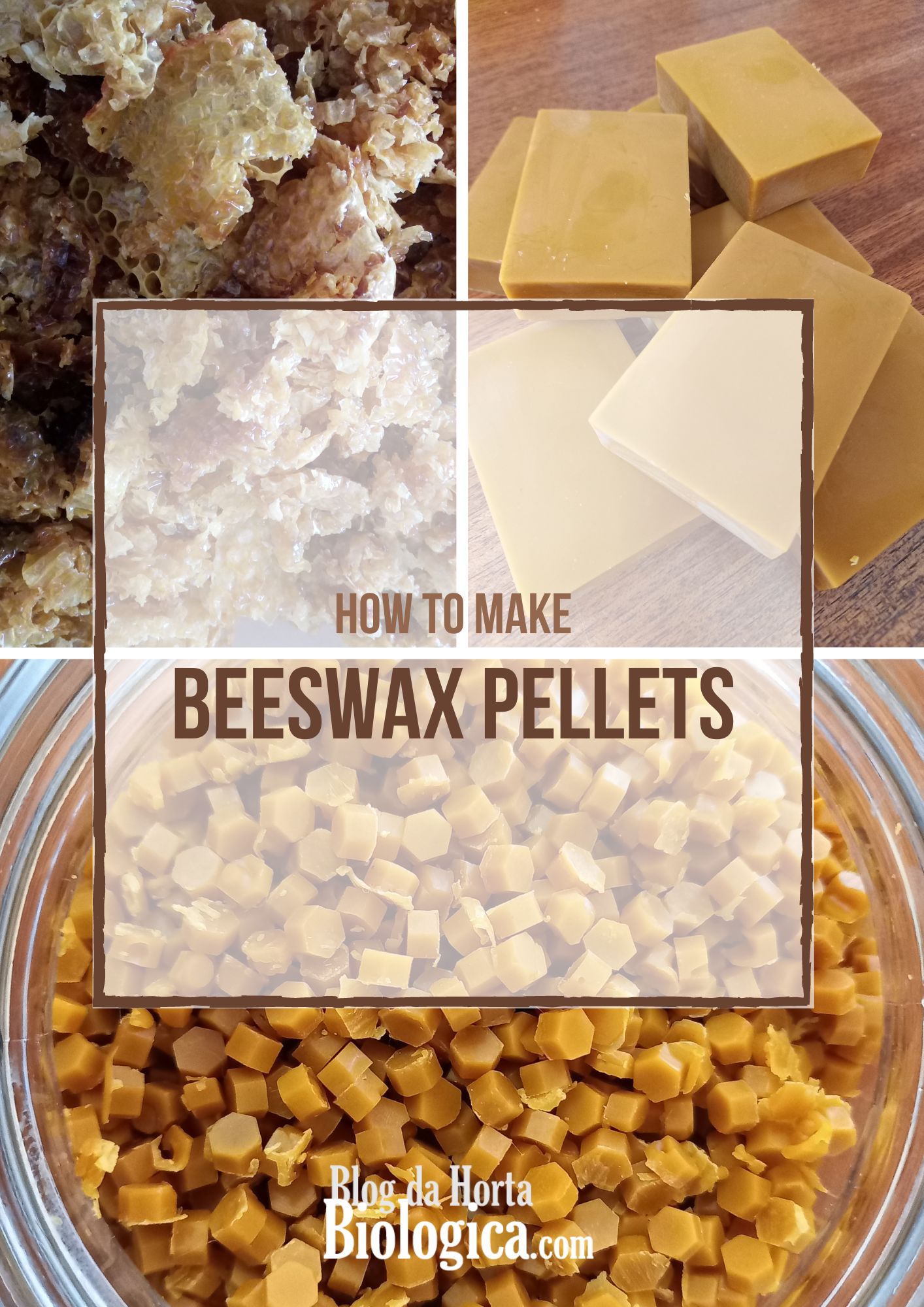
    We have already shown here on the blog how we collect beeswax from our beehives and how we clean the beeswax so that it can be used. We've also shown how to use beeswax in small amounts to make natural moisturizer. But did you know that beeswax can be a pain to use when it is no longer new? That's why it's good to store it in pellets, i.e. granulated form. Before we show you how to do it, you might also like to read our post How to Clean Beeswax: Melting, Filtering, and Storing. At the end of this post, you can also watch the step by step video on how to store beeswax pellets.


    So let's take a look at this homemade method for making these pellets! 


    Materials

    • Beeswax already clean (the amount is the one you have available or the one you want to melt)
    • 1 pan with water up to 2 inches high
    • 1 melting pot proper for melting beeswax (alternatively, a Pyrex can be used)
    • 1 silicone mold suitable for making pellets (we used trivets for this purpose)
    • 1 spatula or similar object for spreading the wax in the mold
    • 1 paper towel or sheet of parchment paper 
    • 1 airtight jar for storing the wax


    Method

    1. Put the beeswax in the melting pot and let it melt it in the pan, in a water bath. The melting point of beeswax is at 70°C (158ºF).
    2. Pour the wax into the mold and spread it with the help of a spatula. The wax should be well distributed throughout the mold.
    3. Allow to cool completely.
    4. Once cold, remove the pellets from the mold using a sheet of paper underneath.
    5. With all the pellets on the sheet of paper, carefully pass them into an airtight jar.
    6. Store the jar in a cool, dry place.

    Beeswax pellets make it easy when we want to use it in small amounts. You might like to watch our post and video Natural Moisturizing Cream | Step by Step Tutorial | Recipe For All Skin Types where we show you how to use beeswax to care for your facial skin.

    Here is our video where we show you everything!


    Herbal Mouthwash | Homemade Mouthwash with Organic Herbs

    Almost anything can be made from plants! It's great to know that we can make our own products at home with simple, natural ingredients that respect our health and the environment...precisely because they come from it! So, today we are going to share with you our recipe for mouthwash with organic plants that are excellent in mouth and throat health care. Great news for those who don't want to spend too much money on the synthetic elixirs that are to be found in supermarkets! At the end of this post you can also watch our step-by-step video of this recipe.


    For this mouthwash, we used plants that we harvested in our own garden. 

    So let's see what the ingredients are and why to use them.


    Ingredients

    • Spearmint (Mentha spicata): 1 small stem is enough.
    • Parsley (Petroselinum crispum): 1 small stem is enough as well.
    • Lemon tree leaf (Citrus limon): 1 leaf. It is important that the leaf is new and tender, and that it is clean and free of pests and diseases.
    • Rosemary (Rosmarinus officinalis): as needed.
    • Fennel seeds (Foeniculum vulgare): as needed.
    • Baking soda: 1/4 tsp.
    • Tea Tree essential oil: 4 drops.
    • Water: enough to make an infusion.


    The plants used in this recipe can be fresh or dried. We used a mixture. The mint, parsley and lemon tree leaf were freshly picked. The rosemary and fennel seeds had been previously picked and were used dried.


    We created this recipe for a 125ml / 4.22oz bottle. In case you are wondering what "a small stem" is, or what the "as needed" or "enough to make an infusion" actually mean, watch the video below so that you will be completely enlightened.


    Why These Ingredients

    Spearmint: is excellent for the digestive system and helps keep a fresh breath.

    Parsley: also fights bad breath and soothes mouth irritation.

    Lemon tree leaf: has anti-inflammatory properties and helps ease canker sores, gingivitis, and relieve throat inflammation.

    Rosemary: is antibacterial and anti-inflammatory. It improves breath and relieves inflammation in the gums.

    Fennel: also has excellent properties for the entire digestive system and is expectorant.

    Baking soda (Sodium bicarbonate): very effective in oral hygiene. It relieves inflammation in the mouth and helps reduce stains on the teeth, keeping them cleaner and whiter.  

    Tea Tree Essential Oil: the champion of the antibacterial essential oils, with great power to disinfect the mouth and helps keep the breath fresh for longer.


    The plants present in this recipe can be changed as long as they have adequate properties for good oral hygiene.

    Learn more about the properties and uses of these and many other plants in our book: "The 5 C's of Aromatic and Medicinal Plants: Cultivate, Care, Collect, Conserve and Consume -  30 Plants and Their Properties".


    Required Materials

    • Kitchen tools for making an infusion.
    • 1 medium-sized glass jar for mixing various ingredients.
    • 1 spoon.
    • 1 funnel.
    • 1 small amber glass bottle with a wide lid. It is advisable to be an amber bottle to better preserve the liquid with essential oil.


    Method

    Now that we have all the ingredients and know why we should use them, let's see how to prepare the mouthwash:

    1. Start by preparing an infusion. The herbs should stay in the water for 5 minutes.
    2. Pour the equivalent of 125ml / 4.22oz into the medium-sized glass jar and let it cool completely. The remaining infusion can be used to prep more mouthwash bottles or for drinking. This is a very nice blend and makes a wonderful tea!
    3. After it has cooled, add 1/4 tsp of baking soda to the infusion and mix well.
    4. Add 4 drops of Tea Tree essential oil (aka Malaleuca) and mix well.
    5. Using a funnel, pour the mixture into the amber glass bottle.
    6. Ready to use!


    How To Use and Conserve

    The amount of mouthwash placed in the lid is sufficient for rinsing and gargling.

    Ideally, you should use it once a day.

    Shake the bottle well before each use.

    It cannot be ingested due to the presence of the essential oil.

    This mouthwash lasts up to 2 months. It does not require refrigeration, but can be stored in the fridge for cooler use.


    We hope you enjoyed our recipe! Have a look at our video with all the details and if you haven't subscribed to our YouTube channel yet, take the opportunity to do so if you don't want to miss a thing!


    VIDEO - Herbal Mouthwash | Homemade Mouthwash with Organic Herbs