" Blog da Horta Biológica: Pests
Mostrar mensagens com a etiqueta Pests. Mostrar todas as mensagens

Potassium Hydroxide Liquid Soap for Garden Pests and Laundry

At the request of our Azorean readers, we're going to teach how to make potassium hydroxide / coconut soap for garden and orchard pests... and more!

First of all, we'd like to thank our readers for following us and trusting in our work, and we'd like to send a big hug to those of you who follow us from the wonderful islands of the Azores!

At the end of this post, you can also watch our educational video where we show you in detail how to make this soap.


For this post, we've formulated a soap that, in addition to having only only a few ingredients, is very effective at fighting pests in the garden and orchard, as well as washing clothes in the home laundry.

Let's start by looking at the ingredients and understanding why each one is used.


Ingredients


  • 141g Cold-pressed extra virgin coconut oil
  • 94g Extra virgin olive oil
  • 60,11g Potassium hydroxide (KOH), 90% pure *
  • 180,32g Distilled water


* Potassium hydroxide is highly hygroscopic, which means it has a strong ability to absorb moisture from the air. For this reason, as soon as it is weighed, it should be immediately sealed in its container, which must be well stored to prevent its deterioration. After sealing the bottle, we place it inside a tightly closed bag and store it in a cabinet to avoid contact with moisture. See the images in the video for a better understanding.


If you don't have a precision scale, round down, never round up.


Important: This soap does not have super fat, so it is not intended for use on the skin!


Why These Ingredients


First of all, it's important to remember that all the ingredients must be of high quality! Sometimes, when the soap is not made for skin use but for pests and laundry, there is a temptation to use low-quality oils. In this case, we strongly advise against it, since the purpose of this soap is also to nourish and care for the plants. 

On the other hand, we also want to stress that this formula has been calculated on the basis of pure oils. Each oil has its own saponification index, which means that if dubious oils are used (i.e. oils that are not truly extra virgin), the result could be a fiasco.

If you've never made soap before and aren't familiar with the process or the technical terms we are using, please read our post first: How To Make Soap.


Let's take a look at each of the ingredients:


  • Cold-pressed extra virgin coconut oil: coconut soap is extremely effective in controlling garden pests (find out more in our post Soap and Vegetable Oil Spray). Additionally, coconut is highly nutritious and is used as an organic fertilizer for the healthy growth and development of plants.
  • Extra virgin olive oil: the oil can be plain or macerated with pest-repellent plants such as peppermint, rosemary, thyme, etc. Find out more about macerations in our post How To Make a Maceration and more about plants and their uses in our book The 5 C's of Aromatic and Medicinal Plants. The use of olive oil in this formula has two functions. One is to add more beneficial properties to the soap, and the other is to achieve a final consistency that is easier to work with, since 100% coconut soap is much thicker and more difficult to break down and dilute.
  • Potassium hydroxide (KOH) 90% pure: potassium is one of the essential nutrients for plants, and potassium soap, in addition to helping control pests, will contribute to plant protection, nutrition and growth. It has to be 90% pure to guarantee effectiveness in the saponification reaction. 

  • Distilled water or rainwater: is used because it is free of impurities, minerals, and contaminants. Distilled water must be used to ensure that the chemical reactions take place as expected and to guarantee the purity, precision and consistency of the final product.


The Materials


To make this soap, you need to gather some materials. The ones we've marked in blue must be used exclusively for making soap because, for food safety reasons, the same materials cannot be used for cooking food and making soap (due to the chemical reactions between fats and potassium hydroxide, also known as caustic potash). 


None of the materials can be made of aluminum because of the reaction with potassium hydroxide!


This list of materials is in the order of use when making soap. 


  • 1 Digital kitchen scale (must be digital for greater accuracy in weighing ingredients)
  • 1 Stainless steel pan
  • 2 bowls for weighing the oils (we recommend weighing them separately in case of mistakes that require adjusting the quantities)
  • 2 tablespoons to help remove the coconut oil from the jar if it is solid
  • 1 Plastic or glass container for the water
  • 1 Plastic or glass container for the potassium hydroxide
  • 1 Pan base
  • 1 Stainless steel spoon to dissolve the hydroxide in the water
  • 1 Kitchen spatula for scraping the bowls with the oils
  • 1 Spatula for stirring the potassium hydroxide solution with the oils
  • 1 Hand blender (yes, it really must be exclusive for soap making!)
  • 1 Digital kitchen thermometer
  • 1 Small spoon (to help with pH tests)
  • 1 Pyrex
  • pH strips
  • 1 Large spoon (to help transfer the soap to a container)
  • 1 Container with lid to store the soap batter at the end
  • 1 Water container
  • 1 Water boiler, which will be very useful for dilution
  • 1 Funnel
  • 1 Container to store the liquid soap in at the end

These are the materials we use. Some of these materials are mandatory, others can be adapted according to what you have at home. Watch our video for a better understanding.


Safety Equipment


As always, safety equipment is more than mandatory, and here are all the necessary elements:

  • Safety goggles
  • Rubber gloves
  • Face mask. Surgical masks (also known as “Covid masks”) are not effective for dealing with chemical reactions, so more closed masks should be used.
  • A long-sleeved lab coat and closed shoes. All skin must be well protected.
See all the safety warnings on soap making in our post How To Make Soap.


How to Make Potassium Hydroxide Liquid Soap


First of all, you should know that the result is never liquid soap, but a thick batter that only becomes gel-like or even liquid once diluted, depending on the dilution ratio.

This soap is made using the Hot Process, meaning the soap will be cooked and will not need to cure once it has been made. Once again, if you don't understand these terms, read our post first: How To Make Soap.


Before we start the step-by-step instructions, we strongly recommend that you have a log book every time you make your own soap, so that you can write down (and later remember) all the important details of each production batch. Here is the notebook we use and recommend to everyone who makes soap at home, whether for personal use, to give away or to sell:


Log book that we use and recommend


So now we're going to share with you how we make this soap at home. Here are all the details:

  1. Start by weighing the empty stainless steel pan (ours weighs 374g). Knowing the weight of the pan will be crucial at the end of the whole process.
  2. Weigh the oils separately, each in its own bowl.
  3. Weigh the water.
  4. Put on all the safety equipment before starting to handle the potassium hydroxide.
  5. Weigh the potassium hydroxide.
  6. Add the oils to the pan (use the kitchen spatula to remove all the oil from the bowls, ensuring there is no waste or significant differences in the amount of oil).
  7. Turn the stove to low heat. (There's no need to heat it up too much, just until the coconut oil melts completely).
  8. While the fats are heating, pour the hydroxide into the water (never the other way around!) and stir with a stainless steel spoon.
  9. Once dissolved, add the water solution to the fats in the pan;

From here on, it's crucial to constantly monitor the temperature while stirring the solution!

    10. Measure the temperature and stir the solution with the spatula that is exclusively for soap making. The temperature of the solution should not exceed 70ºC. For those who have a Crockpot (a pan that maintains the temperature), this won't be a problem, but for those who don't, as in our case, it's necessary to keep putting the pan on and off the heat to make sure it doesn't go over 70ºC.
     11. After stirring the solution a little with the spatula, use the hand blender. Blend the solution for a few minutes, always monitoring the temperature, in a combination of stirring and a little heat from the stove.
     12. When the batter is too thick for the hand blender, use the spatula again. For us, the batter took 8 minutes to reach this point.
       13. When the batter has thickened and is beginning to steam a little, turn off the stove and continue cooking the batter using only the residual heat from the pan.
       14. Once the batter has reached the consistency of a paste where it resembles mashed potatoes, but much thicker, it is probably ready. For this we do the pH test.
      15. To do the pH test, put water in a Pyrex, add just a small amount of the soap paste (for a more reliable result, take it from the inside of the paste and not the outside) and stir well. Then, add a little boiling water as this helps to dissolve the soap paste.
        16. Place a pH strip in the water and check the result. The ideal pH for soap is between 8 and 10. Our paste has a pH of 8, which means that the paste is cooked and the soap is ready.
         17. Allow to cool completely before moving on to the next stage.


Storage and Dilution


To store and dilute, it requires a bit of mathematics, but nothing too complicated.

We got a total weight of paste of 429g. How do we know this? We know because we weighed the tare of the pot at the beginning (374g) and weighed the pot again after the soap paste had cooled (803g).  803-374 = 429g of paste.

For this post and video, we decided to divide the paste in half so that we could demonstrate how to store it and how to dilute it, both for use against garden pests and for home laundry. Let's break it down:

  1. Once the paste has cooled down, we removed about half of it from the pot using a spoon and a spatula.
  2. After this removal, the pan weighed 632g. So, 632 - 374 = 258g. This was the amount that remained in the pan to be diluted.
  3. 429 - 258 = 171g. This was the amount we stored for later dilution.


Storage

The 171g for further dilution has been stored in a plastic container with a lid. It can be stored in a cool place at room temperature.


Laundry Dilution


The 258g that remained in the pot were diluted to make laundry detergent. 

Now, how to dilute it?

The ideal ratio for this is 1:1.5

So 1 part soap to 1.5 parts water (258g x 1.5 = 387g water).


  1. Weigh out 387g of water.
  2. Use a kettle to quickly bring the water to a boil. The hot water will help break down and dissolve the thick paste. Some water is always lost to evaporation when boiling, but for this purpose, it doesn't make much difference.
  3. Add the boiling water to the pan, use the spatula to break up the paste a little, distributing it better throughout the water. Let it sit for a few minutes.
  4. Use the hand blender until it becomes a homogeneous liquid.
  5. Essential oils can be added at this stage. We prefer to use neutral detergent.
  6. Leave it to cool completely.
  7. After it has cooled, use a funnel to pour it into a container suitable for use in the laundry.
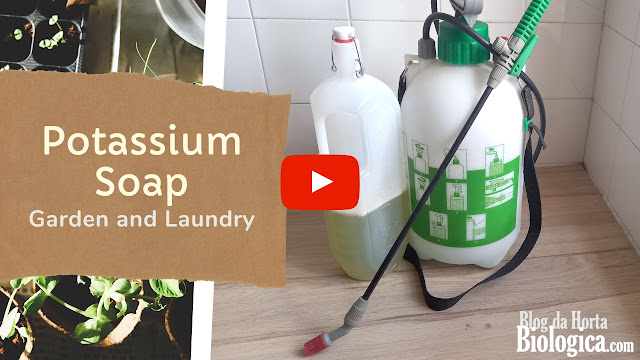
The use of this detergent is the same as for conventional detergents, meaning the recommended doses should be used according to the hardness of the water.


Dilution For Garden Pests


The 171g we saved for later were diluted to spray the pests in the vegetable garden and orchard. 

The dilution ratio for spraying varies depending on the type of soap, the pests to be combated and how heavily the plants are infested. In order to obtain a mild spraying liquid, for lightly infested plants, we will use a maximum of 10L of water for dilution. The 10L makes this easier as we have a 10L pot or two 5L water bottles can be used as an alternative. 

Many sprayers for home gardens are also 5L, so we advise you to make the dilutions according to these proportions, only adjusting the amount of soap according to the severity of the pest attack in the garden.

As this soap is difficult to break down, we recommend starting the dilution in the same way as we did for the laundry detergent, i.e. pour boiling water into the pan in a ratio of 1:1.5, break down and dissolve the soap, and then pour the solution into the pan or divide it between two bottles, filling them to the top with water. That's how you get a soapy spray!


How to Apply in the Garden and Orchard


Transfer the liquid to a sprayer.

The spray should only be used if pests are observed. It should not be used merely as a preventative method.

It should be applied directly to soft-bodied insects such as aphids, lice, mealybugs, caterpillars, whiteflies and moths. Remember not to spray directly on beneficial insects such as ladybugs and bees.

It can be applied once or twice a week, early in the morning or late in the day. Apply to the stems and leaves, not forgetting the back of the leaves where there is a higher concentration of pests.

Avoid applying on windy days and during the hottest hours of the day.


This post is already lengthy, and we hope it has been helpful to our readers! For a better understanding of this entire process, watch our video now, where we show each step in detail.

A big hug to our readers who follow us in the Azores and around the world!


How To Make Fruit Fly Traps | Homemade Natural Recipes

To protect the fruit from pests and obtain a higher yield with quality fruit it is important to set traps on the trees. Pests can cause damage to the plants and are responsible for the loss of a large part of the production. In extreme cases, even total loss. Fortunately, in organic farming there are several ways to fight pests naturally. In this post we will show how we make homemade traps to fight fruit flies in the orchard. At the end of the post, you can also watch our educational video with step by step instructions on how to make these traps.


What Fruit Fly Traps Are Made Of


Fruit fly traps consist of a liquid mixture of sweet smelling or strong smelling ingredients so that the flies are attracted to the smell of the liquid and not the smell of the fruit. The traps can be made at home using natural ingredients, making them a simple and economical way to fight pests. 

Some examples of attractants are:

  • Fruit juice (the riper the better)
  • Rotten fruit juice (can be from the tree itself or other fruit), i.e. fruit that has fallen and rotted or has been attacked by insects and can no longer be eaten
  • Vinegar
  • Water with sugar
  • Water from cooking codfish or other fish

The traps can be placed in bottles, which you can buy at gardening stores, or you can use plastic bottles. This is also an excellent way to reuse these bottles. Both types of bottles have holes that allow the insects to enter. These bottles are then hung on the trees to catch the bugs that attack the fruit.


When to Use the Traps


These traps should be set when the fruit is ripe and begins to release its sweet smell that attracts fruit flies and other insects. 

There are many possible recipes and in this post we will share the two that we usually make at home.


How to Make It


Part I - Preparing the Bottles


We start by preparing the bottles. For these traps we use 1.5L PET bottles.


  1. We start by placing a yellow tape near the top of the bottle. This step is optional but useful, as the yellow color helps to attract the insects.
  2. Under this tape we open four holes with approximately 1cm in diameter. For this task we use a drill, but a hot iron can also be used.
  3. To hang the bottle on the tree, we cut two more holes near the mouth of the bottle, through which we then pass a string. Some people use wire, but we prefer to use a string, because the wire can open wounds on the bark of the tree, for example if the orchard is located in a windy area and the bottle is constantly shaken by the wind. 


Thus, the bottles are ready to receive the insect-attracting liquid. 


Part II - Preparing the Liquid


Now we move on to the attractive liquid recipes. 


Recipe 1 (Made with fruit from the tree itself)


  1. We start by extracting the equivalent of 250ml of fruit juice.
  2. In a container we add 200ml of water + 50g of sugar + the 250ml of fruit juice + 4 TBSP of vinegar.
  3. We mix everything together.
  4. With the help of a funnel we pour into the bottle.


Recipe 2 (Made with banana)


  1. In a blender, we start by mashing one large or two medium bananas. They can be mashed with or without the peel.
  2. Then we add 200ml of water + 50g of sugar + 4 TBSP of vinegar.
  3. We mix everything.
  4. Finally, we pour into the bottle.


The amount of liquid should not exceed 1/4 of the bottle's space. Each of these recipes has sufficient quantities for just one bottle. If you want to prepare two bottles at once you should double the quantities. 


How Traps Work


Flies and other insects are attracted to both the smell of the liquid and the yellow color. They get in through the holes and can no longer get out. Thus, they end up drowning in the liquid.


How to Use the Traps


The bottles should be hung:


  • At least 1.5m high. It also depends on the height of the tree, as the traps should be about the same height of most of the fruit, meaning they should be high enough to catch the insects.
  • South-facing (if you live in the northern hemisphere). When exposed to heat the liquid in the bottles rots faster and the smell becomes even stronger and more attractive.
  • Changed weekly. It is important to keep an eye on the traps, because over time the volume of the liquid, as well as its efficiency, diminishes and becomes less attractive, so it needs to be replaced with new liquid.


The number of bottles to place depends on factors such as the size and configuration of the orchard. Some people place only one or two traps per hectare. Some people place a trap for every certain number of trees. We like to set one trap per tree, since our orchard is small and the trees are more protected. Also of note is that these traps we do, do not stink at great distances so as not to disturb the neighbors. If you make traps that are too smelly you can place fewer traps in the orchard.

A week after setting the traps, the amount of bugs caught can already be seen.


This is how we can keep our orchard fruit healthy and tasty!


For a better understanding of all these steps, take a look at our educational video now, and if you haven't subscribed to our YouTube channel yet, take the opportunity to do so, if you don't want to miss any of our videos.


We hope you find it useful.

Xo Xo from the gardeners!


How to Make Fruit Fly Traps | Homemade Natural Recipes


Soap and Vegetable Oil Spray - Natural Insecticide - Garden and Orchard Pest Control

One of the principles of organic farming is to let biological pest control happen. This consists in letting the beneficial insects attack the insects that harm the plants, such as ladybugs eating aphids. However, this biological pest control is not always enough to protect crops. Hence, it becomes necessary to use natural products to fight the pests. 

Fortunately, there are many natural homemade recipes. You can also find in our blog the recipes for Onion Bug Spray and Coconut Soapy Water. In this post we will talk specifically about Soap and Vegetable Oil Spray that can easily be made at home and then applied to the vegetable garden, flower garden, orchard, and also to indoor plants. At the end of this post you can watch our educational video where we show you how to make this spray step by step.


Benefits of Soap and Vegetable Oil Spray


Soap and vegetable oil spray has long been used to combat pests because of its many benefits:

  • It is easy to make at home
  • The cost of making this spray is very low
  • It is very effective in fighting pests
  • It is natural and environmentally friendly


Recipe


To make this spray, we use 100% coconut soap with no superfat, as it is highly effective in fighting pests. See in this post how to make this soap at home. If you don't want to use this soap, you can make the same recipe with Offenbach soap or potassium soap. 


Ingredients


  • 10 L of water (can be tap water or rain water)
  • 200g of 100% coconut soap with no superfat
  • 100ml vegetable oil (we used olive oil, but it can be another oil. Sunflower oil also works very well)


Materials


  • 1 large pan with 10 L capacity
  • 1 big spoon 
  • 1 grater 
  • 1 funnel
  • 1 jug (to help pour the liquid)


Method


  1. Grate the soap
  2. In a pan, over low heat, place the soap scraps in 5L of water and stir until the soap is well diluted
  3. Gradually add the vegetable oil, stirring constantly
  4. Gradually add the other 5L of water, and keep stirring
  5. Turn off the heat and let it cool
  6. With the help of a funnel and a jug, pour the liquid into the container where it will be stored
  7. Label with the name and date it was made. It can be used for up to 2 years.


How to Apply


The soap and vegetable oil spray should be used as an insecticide, not as a repellent. It should not be sprayed on plants if no pests are present. This spray should be applied directly to soft-bodied insects such as aphids, lice, mealybugs, moths and whiteflies. Soap and oil damage the waxy layer that protects them, asphyxiating them and drying out their airways.

Excessive use can damage the plants, since the oil can block the plant's breathing pores. Application should be done  once or twice a week.

Spraying should always be done in the early morning or evening to avoid the hours of greatest heat. It is also important to avoid spraying on windy days, in order to avoid the waste of spray and to guarantee a good application over the insects.


VIDEO - Vegetable Oil and Soap Syrup - Natural Insecticide - Pest Control for Vegetable Garden and Orchard


Thyme - From Cultivation To Harvesting

Today we are going to talk about cultivation of thyme. There are over 300 species of the genus Thymus and in this post we are going to show you how to grow the species Thymus vulgaris, common thyme. 

See our infographic where we gather all info about its cultivation and, at the end of the post, our educational video where we show all the stages of plant development, from sowing to harvesting and drying the leaves.


Thyme has been cultivated since ancient times for its antiseptic, expectorant, antispasmodic, anti-inflammatory, tonic, and vermicide properties. Nowadays, it is widely used as a condiment, tea, and essential oil. So that this post doesn't get too long we will talk in detail about the properties of thyme in another post. For now we will focus on cultivation methods. 


Thyme is a great plant for people who have little space. It is easy to grow both inside and outside the house and it is a plant that is known for not having problems with pests. As a matter of fact it helps repel insects.

See, in our infographic, the specifications for growing thyme.


Thyme - From Cultivation To Harvesting de Blog da Horta Biológica


Indeed, thyme is a plant that is easy to grow. Watch our video now and, if you haven't subscribed to our channel yet, take the opportunity to do so if you don't want to miss any of our videos!


VIDEO: Thyme - From Cultivation To Harvesting


How To Do Summer Pruning - Simple and Practical Guide For Green Pruning

In this post we are going to talk about summer pruning, also known as green pruning, on fruit trees. The trees we pruned for this post were citrus trees. The principles of green pruning are the same for all trees but it is important to know that citrus trees require less pruning than other trees. If you cut too much they will take a long time to recover and bear fruit again. Citrus trees are perennial, which means that they are evergreen and their leaves don't fall, so they don't have a real period of dormancy. The ideal time for pruning citrus trees should be somewhere between harvesting and the new flowering period, which happens during the spring. Still, green pruning can be done. Although there are several types of pruning, which we will talk about in another post, green pruning must be very light, just to do a little cleaning to the tree. Whether your trees are young or mature you must keep an eye on them to make sure they keep productive and healthy.

We've created this green pruning guide so you can prune your trees in a safe and careful way. For a better understanding make sure you watch our educational video at the end of this post.


When To Do Green Pruning?


Although  we have mentioned that it's done in the summer, there's another curiosity. Some people organize their agricultural tasks according to the moon phases. This is an ancient practice. Usually we don't do it, except for pruning. Sap flows low during the last quarter of the moon, so your trees are less likely to lose sap after cutting. Pruning should be avoided on rainy days, as well as in the early hours of the day before dew as dissipated, to avoid the accumulation of water on the cuts, which could cause the appearance of fungi.


What To Use For Cutting?


In a pruning work, depending on the thickness and height of the branches, you might need these tools: 
  • Hand pruner
  • Lopper
  • Handsaw
  • Telescopic pruner for high trees
  • Chainsaw or reciprocating saw for thicker branches
Bearing in mind that this is a light pruning, you might only need pruning shears and, eventually, the handsaw.

Here are some links for you to see the tools in case you don't know them.


Hand Pruner 
Lopper
Handsaw 
Telescopic
Chainsaw
Reciprocating


Other Important Materials

  • Gardening gloves
  • Ethyl alcohol and a cloth for disinfecting the material

The pruning material must always be sharpened and disinfected before using on each tree, in order to prevent a diseased tree from passing diseases and pests onto other healthy trees. 


What To Cut?


It is always important to remember that green pruning is not a major pruning work, but only a small cleaning work of the tree. Before cutting, you must examine the tree to identify:

  • Branches growing inside the crown
  • Intersecting branches
  • Dead, diseased, and damaged branches and leaves
  • Sucker branches originating from the trunk and the rootstock 
  • Branches that are too long and you might want to shorten


Why To Cut?


Branches that grow inside the crown have to be cut to open the center of the tree. Excess of branches makes each of the branches weaker. By choosing the best and cutting the weakest, the branches will be stronger to support the weight of the fruits. In addition to this, more space is created for better air circulation, for sunlight to reach all fruits, and for having easier access to the inside of the crown in case of spraying against pests and diseases. Anyways, an airy, lit crown helps a lot to prevent the formation of fungi and, consequently, to reduce the need for spraying. Cutting the branches that grow inside also allows to choose and balance the shape of the crown over time. Remember that horizontal branches are more productive, so try to cut vertical branches instead.

Intersecting branches compete with each other and impair both growth and fruiting of each other. Those growing towards the center of the crown should be cut and those growing outside should be favored, as they will contribute to the formation of the crown and will be more productive for their fruits will have better sun exposure.

Dead, diseased, and damaged branches are also useless. Damaged branches can be a gateway for pests and diseases, so cut them right away.


Suckers are very vigorous, vertical, little branched, and can sprout from both trunk and rootstock.


  • Suckers branches from the trunk are useless and hinder the growth of the tree. The tree needs one sturdy trunk and these sprouts consume nutrients, reducing the productivity of the branches.
  • Sucker branches from the rootstock, just like the ones sprouting from the trunk, reduce fruit yield. They grow extremely fast and suck the nutrients that should be consumed by the bearing part of the trees.  

Branches that are too long become weaker and risk breaking when supporting the weight of the fruit. Cutting these branches makes them stronger while allowing you to define the layout of the crown.


How To Cut?


Suckers can be gently removed by hand if they are small and newly formed or with pruning shears if they have woody stems.

Other branches must be cut at the branch collar swelling, that is, the swollen part where the branch meets the trunk. This is a favorable area for healing. If you cut it right and the collar is left intact, the wound will seal more effectively. This is also crucial to protect the trees against pests and diseases. For thinner branches use the hand pruner. For thicker branches use the lopper.

It is also common to find healthy and dead twigs on the same branch. In this case, cut the dead twig back where it meets the branch.

The ideal cut must be precise and carried out at once, with an angle of approximately 45º. Doing this avoids the accumulation of water, which can cause the rotting of the branch and the appearance of fungi.

After pruning, a sealing paste should be applied to the cuts, so that they heal more quickly and are not exposed to the elements that can cause diseases. Use a paintbrush and apply the paste over the stub and around the edges to ensure it covers the whole cut area.

In our video you can see exactly how to cut and the quantity of branches that were removed from one single tree.

The summer is out there, so...get to work! :)


VIDEO - How To Make Summer Pruning


Onion Bug Spray - Natural Pest Repellent

In our long journey in organic farming one of our priorities has always been the natural protection of plants, without using products that are harmful for the environment. Fortunately, there are many ways to fight pests using all-natural ingredients. In this post we will show you how to make an onion bug spray to protect the plants both in the garden and in pots. Watch our educational video at the end of the post.


Onion has excellent properties to repel garden pests, in addition to being a source of macro and micronutrients for the development of plants. Onion spray repels insects and prevents the appearance of fungi, with the advantage of not repelling bees that are so important for the entire ecosystem. This spray is especially indicated against aphids, mealybugs, caterpillars, and for powdery mildew.


How To Make It?


Onion bug spray is nothing but an infusion of onion skin in water. Let's see how to do it:

  1. In a pan, place the skin of 3 large onions. Garlic skin can also be added but onion by itself makes a very effective repellent.
  2. Add 1L of water.
  3. Boil for 3 to 5 minutes.
  4. Turn off the heat, let it cool down, and strain.
The onion skin can be placed on the plant's base as a natural fertilizer.
The spray can be stored at room temperature. There's no need to keep in the fridge. 


How To Use It?


This spray is very concentrated, so it must be diluted. 

For heavily attacked plants - 1 glass of onion liquid to 2 glasses of water. Apply directly to the insects. 

For prevention - 1 glass of onion liquid to 4 glasses of water. Apply to the leaves and stems.

Spraying should be done early in the morning or at the end of the day to avoiding the hours of greatest heat.

Spray once or twice a week as needed.


It is so simple that there's no excuse for not doing it! Take care of your plants in a natural way. It is simple, it is economical, and it is healthy for the environment and for all of us who are part of it.


VIDEO - Onion Bug Spray


Intercropping Guidelines For Organic Farming

The month of May is the time for many farm chores, from sowing to harvesting, and crop protection against pests and diseases. Precisely to avoid pests and prevent possible diseases, today we are talking about intercropping. 


Intercropping is one of the principles of organic farming and is practiced for several reasons. Let's see what they are:

  • The cultivation area must have diversified crops in order to assure a varied production, which contributes to the enrichment of organic matter in the soil.
  • The diversity of crops attracts "garden friends" (insects and other little creatures) that contribute to avoid the use of pesticides, thus obtaining foods of high nutritional value.
  • In addition to promoting biodiversity, intercropping prevents soil depletion, which often happens in monoculture fields.
  • Some plants benefit from each other through their proximity, in some cases due to the diversified use of soil resources without competition between them, in other cases due to the repellent effect of pests through the smells and substances they produce. 

Although intercropping has all these benefits, it is very important to know which crops benefit from each other's proximity and which ones should be grown at a distance. See, in our table, the favorable and unfavorable associations so you can better organize your kitchen garden. 


There are also some plants that protect the garden in general and, therefore, it is a good idea to plant them around the beds.

Lavender - Repels various pests.
Garlic - Repels aphids and prevents fungi.
Rue - Repels cats and ants.
Marigold - Keeps away most of garden pests.
Monks cress - Works as a pest trap for both garden and orchard.
Coriander - Keeps away mites and aphids.
Lemon balm - Repels various insects.
Pennyroyal mint - Keeps away rats and ants.
Sage - Repels various pests.
Savory - Repels various pests.


With this precious information we hope you will be able to protect your crops in the most natural way possible, taking into account the environment and health.


Enjoy your crops!