" Blog da Horta Biológica: Kitchen Garden
Mostrar mensagens com a etiqueta Kitchen Garden. Mostrar todas as mensagens

Potassium Hydroxide Liquid Soap for Garden Pests and Laundry

At the request of our Azorean readers, we're going to teach how to make potassium hydroxide / coconut soap for garden and orchard pests... and more!

First of all, we'd like to thank our readers for following us and trusting in our work, and we'd like to send a big hug to those of you who follow us from the wonderful islands of the Azores!

At the end of this post, you can also watch our educational video where we show you in detail how to make this soap.


For this post, we've formulated a soap that, in addition to having only only a few ingredients, is very effective at fighting pests in the garden and orchard, as well as washing clothes in the home laundry.

Let's start by looking at the ingredients and understanding why each one is used.


Ingredients


  • 141g Cold-pressed extra virgin coconut oil
  • 94g Extra virgin olive oil
  • 60,11g Potassium hydroxide (KOH), 90% pure *
  • 180,32g Distilled water


* Potassium hydroxide is highly hygroscopic, which means it has a strong ability to absorb moisture from the air. For this reason, as soon as it is weighed, it should be immediately sealed in its container, which must be well stored to prevent its deterioration. After sealing the bottle, we place it inside a tightly closed bag and store it in a cabinet to avoid contact with moisture. See the images in the video for a better understanding.


If you don't have a precision scale, round down, never round up.


Important: This soap does not have super fat, so it is not intended for use on the skin!


Why These Ingredients


First of all, it's important to remember that all the ingredients must be of high quality! Sometimes, when the soap is not made for skin use but for pests and laundry, there is a temptation to use low-quality oils. In this case, we strongly advise against it, since the purpose of this soap is also to nourish and care for the plants. 

On the other hand, we also want to stress that this formula has been calculated on the basis of pure oils. Each oil has its own saponification index, which means that if dubious oils are used (i.e. oils that are not truly extra virgin), the result could be a fiasco.

If you've never made soap before and aren't familiar with the process or the technical terms we are using, please read our post first: How To Make Soap.


Let's take a look at each of the ingredients:


  • Cold-pressed extra virgin coconut oil: coconut soap is extremely effective in controlling garden pests (find out more in our post Soap and Vegetable Oil Spray). Additionally, coconut is highly nutritious and is used as an organic fertilizer for the healthy growth and development of plants.
  • Extra virgin olive oil: the oil can be plain or macerated with pest-repellent plants such as peppermint, rosemary, thyme, etc. Find out more about macerations in our post How To Make a Maceration and more about plants and their uses in our book The 5 C's of Aromatic and Medicinal Plants. The use of olive oil in this formula has two functions. One is to add more beneficial properties to the soap, and the other is to achieve a final consistency that is easier to work with, since 100% coconut soap is much thicker and more difficult to break down and dilute.
  • Potassium hydroxide (KOH) 90% pure: potassium is one of the essential nutrients for plants, and potassium soap, in addition to helping control pests, will contribute to plant protection, nutrition and growth. It has to be 90% pure to guarantee effectiveness in the saponification reaction. 

  • Distilled water or rainwater: is used because it is free of impurities, minerals, and contaminants. Distilled water must be used to ensure that the chemical reactions take place as expected and to guarantee the purity, precision and consistency of the final product.


The Materials


To make this soap, you need to gather some materials. The ones we've marked in blue must be used exclusively for making soap because, for food safety reasons, the same materials cannot be used for cooking food and making soap (due to the chemical reactions between fats and potassium hydroxide, also known as caustic potash). 


None of the materials can be made of aluminum because of the reaction with potassium hydroxide!


This list of materials is in the order of use when making soap. 


  • 1 Digital kitchen scale (must be digital for greater accuracy in weighing ingredients)
  • 1 Stainless steel pan
  • 2 bowls for weighing the oils (we recommend weighing them separately in case of mistakes that require adjusting the quantities)
  • 2 tablespoons to help remove the coconut oil from the jar if it is solid
  • 1 Plastic or glass container for the water
  • 1 Plastic or glass container for the potassium hydroxide
  • 1 Pan base
  • 1 Stainless steel spoon to dissolve the hydroxide in the water
  • 1 Kitchen spatula for scraping the bowls with the oils
  • 1 Spatula for stirring the potassium hydroxide solution with the oils
  • 1 Hand blender (yes, it really must be exclusive for soap making!)
  • 1 Digital kitchen thermometer
  • 1 Small spoon (to help with pH tests)
  • 1 Pyrex
  • pH strips
  • 1 Large spoon (to help transfer the soap to a container)
  • 1 Container with lid to store the soap batter at the end
  • 1 Water container
  • 1 Water boiler, which will be very useful for dilution
  • 1 Funnel
  • 1 Container to store the liquid soap in at the end

These are the materials we use. Some of these materials are mandatory, others can be adapted according to what you have at home. Watch our video for a better understanding.


Safety Equipment


As always, safety equipment is more than mandatory, and here are all the necessary elements:

  • Safety goggles
  • Rubber gloves
  • Face mask. Surgical masks (also known as “Covid masks”) are not effective for dealing with chemical reactions, so more closed masks should be used.
  • A long-sleeved lab coat and closed shoes. All skin must be well protected.
See all the safety warnings on soap making in our post How To Make Soap.


How to Make Potassium Hydroxide Liquid Soap


First of all, you should know that the result is never liquid soap, but a thick batter that only becomes gel-like or even liquid once diluted, depending on the dilution ratio.

This soap is made using the Hot Process, meaning the soap will be cooked and will not need to cure once it has been made. Once again, if you don't understand these terms, read our post first: How To Make Soap.


Before we start the step-by-step instructions, we strongly recommend that you have a log book every time you make your own soap, so that you can write down (and later remember) all the important details of each production batch. Here is the notebook we use and recommend to everyone who makes soap at home, whether for personal use, to give away or to sell:


Log book that we use and recommend


So now we're going to share with you how we make this soap at home. Here are all the details:

  1. Start by weighing the empty stainless steel pan (ours weighs 374g). Knowing the weight of the pan will be crucial at the end of the whole process.
  2. Weigh the oils separately, each in its own bowl.
  3. Weigh the water.
  4. Put on all the safety equipment before starting to handle the potassium hydroxide.
  5. Weigh the potassium hydroxide.
  6. Add the oils to the pan (use the kitchen spatula to remove all the oil from the bowls, ensuring there is no waste or significant differences in the amount of oil).
  7. Turn the stove to low heat. (There's no need to heat it up too much, just until the coconut oil melts completely).
  8. While the fats are heating, pour the hydroxide into the water (never the other way around!) and stir with a stainless steel spoon.
  9. Once dissolved, add the water solution to the fats in the pan;

From here on, it's crucial to constantly monitor the temperature while stirring the solution!

    10. Measure the temperature and stir the solution with the spatula that is exclusively for soap making. The temperature of the solution should not exceed 70ºC. For those who have a Crockpot (a pan that maintains the temperature), this won't be a problem, but for those who don't, as in our case, it's necessary to keep putting the pan on and off the heat to make sure it doesn't go over 70ºC.
     11. After stirring the solution a little with the spatula, use the hand blender. Blend the solution for a few minutes, always monitoring the temperature, in a combination of stirring and a little heat from the stove.
     12. When the batter is too thick for the hand blender, use the spatula again. For us, the batter took 8 minutes to reach this point.
       13. When the batter has thickened and is beginning to steam a little, turn off the stove and continue cooking the batter using only the residual heat from the pan.
       14. Once the batter has reached the consistency of a paste where it resembles mashed potatoes, but much thicker, it is probably ready. For this we do the pH test.
      15. To do the pH test, put water in a Pyrex, add just a small amount of the soap paste (for a more reliable result, take it from the inside of the paste and not the outside) and stir well. Then, add a little boiling water as this helps to dissolve the soap paste.
        16. Place a pH strip in the water and check the result. The ideal pH for soap is between 8 and 10. Our paste has a pH of 8, which means that the paste is cooked and the soap is ready.
         17. Allow to cool completely before moving on to the next stage.


Storage and Dilution


To store and dilute, it requires a bit of mathematics, but nothing too complicated.

We got a total weight of paste of 429g. How do we know this? We know because we weighed the tare of the pot at the beginning (374g) and weighed the pot again after the soap paste had cooled (803g).  803-374 = 429g of paste.

For this post and video, we decided to divide the paste in half so that we could demonstrate how to store it and how to dilute it, both for use against garden pests and for home laundry. Let's break it down:

  1. Once the paste has cooled down, we removed about half of it from the pot using a spoon and a spatula.
  2. After this removal, the pan weighed 632g. So, 632 - 374 = 258g. This was the amount that remained in the pan to be diluted.
  3. 429 - 258 = 171g. This was the amount we stored for later dilution.


Storage

The 171g for further dilution has been stored in a plastic container with a lid. It can be stored in a cool place at room temperature.


Laundry Dilution


The 258g that remained in the pot were diluted to make laundry detergent. 

Now, how to dilute it?

The ideal ratio for this is 1:1.5

So 1 part soap to 1.5 parts water (258g x 1.5 = 387g water).


  1. Weigh out 387g of water.
  2. Use a kettle to quickly bring the water to a boil. The hot water will help break down and dissolve the thick paste. Some water is always lost to evaporation when boiling, but for this purpose, it doesn't make much difference.
  3. Add the boiling water to the pan, use the spatula to break up the paste a little, distributing it better throughout the water. Let it sit for a few minutes.
  4. Use the hand blender until it becomes a homogeneous liquid.
  5. Essential oils can be added at this stage. We prefer to use neutral detergent.
  6. Leave it to cool completely.
  7. After it has cooled, use a funnel to pour it into a container suitable for use in the laundry.
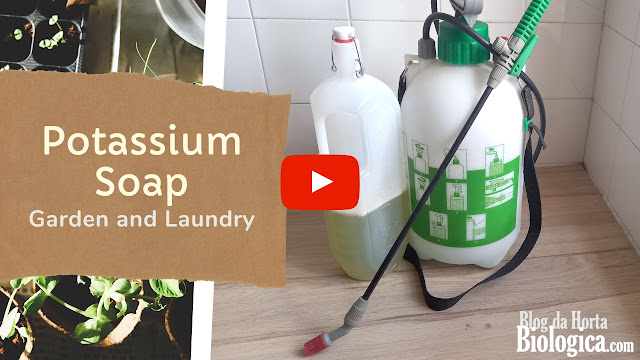
The use of this detergent is the same as for conventional detergents, meaning the recommended doses should be used according to the hardness of the water.


Dilution For Garden Pests


The 171g we saved for later were diluted to spray the pests in the vegetable garden and orchard. 

The dilution ratio for spraying varies depending on the type of soap, the pests to be combated and how heavily the plants are infested. In order to obtain a mild spraying liquid, for lightly infested plants, we will use a maximum of 10L of water for dilution. The 10L makes this easier as we have a 10L pot or two 5L water bottles can be used as an alternative. 

Many sprayers for home gardens are also 5L, so we advise you to make the dilutions according to these proportions, only adjusting the amount of soap according to the severity of the pest attack in the garden.

As this soap is difficult to break down, we recommend starting the dilution in the same way as we did for the laundry detergent, i.e. pour boiling water into the pan in a ratio of 1:1.5, break down and dissolve the soap, and then pour the solution into the pan or divide it between two bottles, filling them to the top with water. That's how you get a soapy spray!


How to Apply in the Garden and Orchard


Transfer the liquid to a sprayer.

The spray should only be used if pests are observed. It should not be used merely as a preventative method.

It should be applied directly to soft-bodied insects such as aphids, lice, mealybugs, caterpillars, whiteflies and moths. Remember not to spray directly on beneficial insects such as ladybugs and bees.

It can be applied once or twice a week, early in the morning or late in the day. Apply to the stems and leaves, not forgetting the back of the leaves where there is a higher concentration of pests.

Avoid applying on windy days and during the hottest hours of the day.


This post is already lengthy, and we hope it has been helpful to our readers! For a better understanding of this entire process, watch our video now, where we show each step in detail.

A big hug to our readers who follow us in the Azores and around the world!


Natural Plant Fertilizer | 3 Ingredients | 7 Ways To Use

Today we are going to share a homemade, natural recipe for fertilizing plants. With 3 ingredients only, which can be used individually or together, this is a very complete recipe to provide optimal growing conditions in a balanced, nutrient-rich soil. 

These tips and recipes are also in our book: The 5 C's of Aromatic and Medicinal Plants - Cultivate, Care, Collect, Conserve and Consume - 30 Plants and Their Properties. At the end of this post, you can also watch our educational video where we show, in detail, all the ways to use them.


This homemade fertilizer is very simple and inexpensive, consisting of ingredients as simple as eggshells, banana peels, and coffee grounds. These ingredients that you already have in your kitchen will do wonders for your plants! Let's see why we should use them.


Why These Ingredients?

Plants mainly need nitrogen (N), phosphorus (P), and potassium (K) for a balanced and healthy development. Eggs, bananas, and coffee provide each of these nutrients.

  • Eggshells are rich in calcium (Ca), magnesium (Mg), and potassium (K), which enrich the soil and contribute to optimal plant growth. Eggshells are also used to correct the most acidic soils.

  • Banana peels are an excellent source of potassium (K) and phosphorus (P), also providing calcium (Ca) and magnesium (Mg) to plants.

  • Coffee grounds have all 3 main ingredients, nitrogen (N), phosphorus (P), and potassium (K). Because of their acidity, they can also be used to correct more alkaline soils.


Ways to Use


There are many simple ways to use these ingredients, which makes them excellent allies in plant care, especially when you are have little time. Let's look at the various ways to use these ingredients, individually or together.


Using the Ingredients Individually


#1 Using the Whole Eggshells

Ideally, you should break the shells into small pieces with your hands and mix them with the soil. When left on the surface, they are also an excellent trap for slugs and snails.


#2 Using Powdered Eggshells

When crushed and reduced to powder, they are more easily absorbed by the soil. Grind with a coffee grinder and sieve. For this task we recommend wearing a mask so as not to inhale the powder


#3 Banana Peels Cut Into Pieces

Instead of discarding banana peels or putting them in the compost pile, they can be cut into small pieces and mixed with the soil near the base of the plants.


#4 Banana Peel Decoction

An decoction of banana peel is used to spray or water plants.

  1. Separate peels of 2 large bananas into 1L of water.
  2. Boil for 5 minutes.
  3. Allow to cool and strain.

    As it is a concentrated liquid it must be diluted in water.
  • To spray: 1 cup of decoction to 4 cups of water.
  • For watering: 1 cup of decoction to 2 cups of water.

Apply this fertilizer every two weeks.


#5 Coffee Grounds at the Base of the Plants

Apply some coffee grounds around the base of the plant and mix with the soil for a better result.


Using the Ingredients Together


#6 Eggshells + Coffee grounds

The mixture of eggshells and coffee grounds contributes to a balanced soil.


#7 Eggshells + Banana peels + Coffee grounds

The mixture of the 3 ingredients: eggshells, banana peels, and coffee grounds constitutes a very complete and effective natural fertilizer for plant growth.

  1. Select 3 equal parts of each ingredient (one cup of each, for example). 
  2. Place in the food processor and grind. 
  3. Add water as needed to obtain a creamy texture.
  4. Apply around the base of the plants once every two weeks.

These natural fertilizers can be used on both small plants and trees. Because they are so simple and do not have unpleasant smells, you can make them even if you live in an apartment and have the plants in the kitchen.

We hope you have enjoyed all the tips. Take a look now at our educational video. If you haven't subscribed to our YouTube channel yet, take the opportunity to do so if you don't want to miss a thing!

Xo Xo


Wild Blackberry Jam - Homemade Super Delicious Recipe

It was back in the summer that we made this wild blackberry jam and today we share with you our recipe.

Making jams from wild berries is a fun activity to do with the family. We picked the blackberries from the brambles that insist on growing in our garden, but if you don't have a garden you can take a walk in the countryside or in the woods, pick the fruits and then make several types of sweets.

Let's see how to make this recipe. At the end of this post you can also see our educational video where we show, not only the step by step recipe, but also a little of the development of the plant, from the flower and pollination to harvesting the fruit.


Ingredients

  • 2Kg Wild blackberries
  • 1,3Kg Brown Sugar
  • 3 Cinnamon sticks
  • Juice of 2 small lemons


Tools

  • 1 Large deep pot
  • 1 Hand blender
  • 1 Citrus squeezer
  • 1 Large wooden spoon
  • 1 Kitchen tongs or 2 large spoons
  • Several pre-sterilized glass jars
  • Utensils for pouring the jam into the jars. Depending on the size of the jars, these can be spoons, funnels, or whatever else you have in the kitchen that might come in handy for this task.


Method

  1. Start by washing the blackberries.
  2. Place the blackberries in a deep pot.
  3. Add 3 cinnamon sticks, the sugar and the lemon juice.
  4. With a large wooden spoon, mix everything.
  5. Turn on the heat to high.
  6. When it starts boiling, lower the heat to minimum.
  7. After 10 minutes, remove the cinnamon sticks using a kitchen tongs or two large spoons.
  8. Let simmer for 40 minutes and stir occasionally.
  9. After 40 minutes turn off the heat and transfer the jam immediately to the jars so they can be vacuum sealed.


Important Tips

Before turning off the heat you should check if the jam is just right, in other words, if it is thick enough. If it is still too liquid, you should leave it on the heat a little longer. If, when passing the spoon over the jam, it forms a fine thread, it is ready. Be careful not to make it too thick!

To vacuum seal the jars, you must transfer all the jam immediately while it is still very hot, close the jars tightly, and store them upside down so that all the air can come out of the jars. When vacuum happens, you hear the lid make a clicking sound. You can also tell if it has vacuumed if the lid is sucked down. Jars that don't vacuum should be stored in the refrigerator and be the first to be consumed. Those that vacuum can be stored in a cool, dry place and can last for several years.


This recipe is made with blackberries, but the same method can be followed for other berries. We hope you enjoy it! 

Here is our step by step video and some beautiful images of the blackberries developing before the harvest.


VIDEO - Wild Blackberry Jam - Homemade Super Delicious Recipe


Stevia - How To Make Liquid and Powder Extract | Benefits | True Stevia vs Fake Stevia

Stevia (Stevia rebaudiana) is a sweet plant, native to South America, known to be a healthy substitute for sugar.

We have been receiving a few emails with questions about stevia, especially the one on sale in supermarkets. This is a good sign, as these questions show a growing concern for leading a healthier lifestyle, eschewing industrial and refined products. 

Did you know that the stevia sweetener you buy in supermarkets is not real stevia sweetener? It is often said, and rightly so, that we are always being misled!

The good news is that even stevia sweetener can be made at home. In addition to having more control over its quality, making things with your own hands also gives great satisfaction.  There's nothing like what's homemade!


In this post we will share:

  • What are the benefits of stevia
  • How to distinguish it from the products you buy
  • How to make the liquid and powder extract
  • How to use


After all, you don't need a sugar cane plantation to make sugar at home! All you need is a pot of stevia! If you do not want to sow, you can buy pots of this plant in nurseries and garden shops.

Before showing how to make stevia extract let's talk a bit about this very special plant.


Benefits and Curiosities of Stevia


Diabetes and Obesity
  • Although its extract is substantially sweeter than sugar, stevia contains no calories which makes it an ideal sweetener for people with diabetes and those who want to fight obesity.
  • Helps maintain proper insulin and blood glucose levels.
  • Helps to control appetite.


Oral health
  • Its enzymes and high vitamin C content help protect from inflammation of the gums, reduce plaque and the appearance of cavities.
  • In Japan (one of the largest consumers of stevia in the world) it is used to make toothpaste, chewing gum and medicinal products to protect against bleeding gums and sore throat.


Cosmetics
  • Apart from culinary applications, stevia also has cosmetic applications and can be used to make homemade moisturizers, as it tones, cleanses and softens the skin.


Other treatments 
  • In some countries stevia is approved as a sugar substitute and is already used to treat hypertension, depression, fatigue, infections, skin problems, and sugar addiction.


All these benefits make stevia a healthy, long-lasting and affordable home sweetener.


It is important to remember that regardless of these benefits, and as we have indicated before in the post about Turmeric, to avoid overuse of superfoods it is advisable to speak to a nutritionist. If you are diabetic you should also consult your doctor for correct use, adapted to your particular case.


How to Distinguish from Store-bought Stevia


Ever since stevia appeared on the market, many fake products have been placed on supermarket shelves.

By making stevia sweetener at home, you can be sure that you are consuming real stevia. Apart from being a simple process it also saves you a lot of money.


Real or Pure Stevia

  • It does not taste like sugar and is not white like sugar. It is green.
  • It has a sweet taste, although not as sweet as industrialized stevia as processed stevia has other forms of added sugars.
  • The taste of pure stevia is sweet when used in very small amounts. If too much is used, it becomes very bitter indeed!


Fake Stevia or Industrialized Stevia

  • It is white, usually granulated, and very similar to refined sugar.
  • Industrialized stevia does not have the same medicinal properties as pure stevia because it is altered through industrial processes where other forms of sugar are added, in order to make stevia more commercially attractive.


Many brands of stevia on sale have additives and hidden sugars. Some ingredients commonly found on setvia package labels, such as dextrose, sorbitol and erythritol, are added sugars. These are white, water-soluble and industrially produced for use as sweeteners.


How to Make Stevia Extract


Since store-bought stevia is what is is, why not make it at home? Let's see how to make liquid and powder extract in a simple way. 


Liquid

To make liquid extract use fresh or dried leaves. Powder can also be used, but this can make the process more difficult when it comes to straining.  

Various solvents can be used: alcohol, water or glycerin. When making with water or glycerin, the shelf life is very short. As only a small amount of extract is needed for each use, it is important that it lasts for months or years. So, here is how to make an alcohol extract.

  1. Put the leaves (fresh or dried / cut or whole) in a jar. Do not use the stems.
  2. Cover the leaves with unflavored, consumable alcohol such as brandy or vodka.
  3. Cover the jar and store in a cool, dark place for 24-36 hours, shaking the jar occasionally.
  4. After this time, strain using a sieve, coffee filter or nut milk bag.
  5. Using a funnel, pour into an amber glass jar with a pipette.
  6. Label with date.
  7. Store in a dark, cool, dry place.

There are no exact amounts for making this extract. It is advised that only a few leaves and a little alcohol is used. The larger the quantity of ingredients, the sweeter and stronger the taste. It is also important to remember that you only need to use a very small amount at a time, which means that a small bottle will last for a long time.


Alcohol But Not Too Much

While consumable alcohol is an excellent preservative that will preserve the stevia extract for several years, one must be remember that these drinks also have their sweetness. So, if you do not tolerate alcohol well or want to reduce the sweetness at the end result,  you can still do an additional step before storing.

  • After straining, heat the extract over low heat for 20-30 minutes, without letting it boil;
  • After this step, pour into the jar and store.

Placing over low heat will cause the extract to reduce the alcohol content. However, it will also reduce the shelf life of the liquid which should be refrigerated and consumed within 3 months.


Powder


Picking and Drying Leaves

The leaves can be harvested throughout the summer, but are sweetest in early autumn/fall when the weather gets cooler and flowering begins.

  1. Cut the plants at the base leaving 15cm for them to grow again.
  2. Wash under running water.
  3. Pick the leaves. The leaves are much sweeter than the stem. The stem is not used and should be placed in the compost pile.
  4. Let the leaves dry. Some people use a dehydrator, but leaves dry well on their own and there is no need to use electricity. They can be dried indoors or open air, preferably in the shade. The drying time will depend on the air temperature. Ideally, leaves can be left to dry for a fortnight.


Grind

When the leaves are well dried, it is time to move on to extracting the powder. The process is quite simple:

  1. To grind the leaves, use a food processor or a coffee grinder.
  2. To make a very fine powder, use a sieve.

Store in an airtight jar in a cool, dry place.


How to Use


Both stevia liquid and powder can be stored for several years. You can also store the dried leaves and grind as needed.

Because it is sweeter than sugar, each use requires only a small amount. 3 to 4 teaspoons of stevia powder is equivalent to 1 cup of refined sugar, so when using stevia for cooking, you need to keep in mind that the amounts, texture and properties will be different.

The uses in food are many. From sweetening coffee, tea and juice, to making sweets, baking or roasting.


To sweeten, it can be used in 3 ways:

In powder form: crushed dried leaves to sweeten drinks.

In liquid form: also used to sweeten drinks or confectionery. You can use the extract already made or make an infusion.

Fresh leaves: the leaves are sweet and can be added to fruit salad or tea. They can also be used for making sweet and sour sauce, seasonings and cooking.


So, we hope we have helped clear up many doubts that have arisen about stevia.

Until the next post... take care!


Sage - From Cultivation to Harvesting

Sage (Salvia officinalis) is an aromatic and medicinal herb, also cultivated as an ornamental plant. It is widely used as a condiment in many cuisines around the world and has been used since ancient times to cure various ailments, in such a way that its name "salvia" in Latin means "to cure". It is a plant to which numerous medicinal properties are attributed, with internal and external uses and, nowadays, studies are still carried out on its effects on health. 

Those who do not have a garden can also enjoy the benefits and aroma of this plant, as sage can also be grown in pots. So let's see how to grow sage.


Watch our infographic for all the information on sage and how to grow it, from cultivation to harvesting time.


Sage de Blog da Horta Biológica


Coriander - From Cultivation to Harvesting

Coriander (Coriandrum sativum) is a seasoning herb that is used as a condiment all over the world. With its characteristic flavour and aroma, it is part of many everyday dishes and the best thing about it is that its cultivation is simple and the growing cycle is short. Some people like it, others can't stand its smell or taste, still this herb has been used since ancient times and numerous medicinal properties are attributed to it.


In this post, we are going to talk specifically about growing this plant. So let's see how to look after coriander, from cultivation to harvesting.


Coriander de Blog da Horta Biológica


Oregano - From Cultivation to Harvesting

Oregano is a plant of the genus Origanum of which there are more than 200 species. In this post we will talk about the cultivation of the species Origanum vulgare, which is widely used in various cuisines of the world, but mainly in the Mediterranean cuisine. It is also considered a medicinal herb for its antioxidant and antibacterial properties. 


In Portugal, in late spring and early summer, oregano can be found in the fields, where it grows spontaneously. For those who don't want to harvest or don't have access to native plants, here is a step-by-step guide to growing it in pots or in the garden.


Oregano de Blog da Horta Biológica


Lavender - From Cultivation to Harvesting

Lavender is one of the most versatile and appreciated plants, both by humans and insects. Melliferous, fragrant and with multiple medicinal properties, it is used to decorate homes and gardens and in aromatherapy as a relaxant and soothing, and is also suitable for caring for all skin types. There are more than 30 species and, in this post, we will talk about the cutivation of the species Lavandula angustifolia.


Lavandula angustifolia is the species that is most used in perfumery and the production of essential oils and does not exist naturally in Portugal. It can be seen in many gardens in our country, but it has to be cultivated. Let's see how to grow this beautiful plant.


Lavender de Blog da Horta Biológica