" Blog da Horta Biológica: Wellness
Mostrar mensagens com a etiqueta Wellness. Mostrar todas as mensagens

Natural Syrup with Herbs, Lemon, and Honey | For Dry Cough and Flu Symptoms

At home we like to grow plants and to make the most out of them. That's why we use them far beyond food. Plants are also wonderful for improving physical and emotional well-being. So today we are going to share one more tip. We will show you how we make natural syrup with herbs, lemon, and honey. All the ingredients we use are from our production, organic, in their purest state, and are all suitable for flu. At the end of the post you can also watch our educational video, where we show you everything step by step.


This syrup is indicated to relieve cough, sputum, and throat inflammation. In creating our own natural syrup recipe, we took into account the ingredients we had available at the time and the healing and medicinal properties of each one. So let's start by getting to know the ingredients:


Ingredients


  • Water - 200ml / 6.76oz
  • Herbs (Oregano and Thyme) - 25g / 0.88oz leaves. (The leaves should be removed from the stems so they are in full contact with the water during decoction and maceration).
  • Lemon - 50ml / 1.69oz squeezed lemon juice. The number of lemons needed to obtain 50ml of juice is variable, depending on the size of the lemons and the amount of juice and pulp present in each one.
  • Raw Honey - 150g / 5.29oz. It is important that the honey is multifloral and does not have a strong aftertaste, otherwise the syrup may become undrinkable.


For this recipe we harvested oregano and thyme that grow spontaneously in our garden. However, they are also easy to grow in a pot. Thyme is particularly interesting to grow, as it is a plant that is available all year round. See this post on how to grow thyme.

The lemons were harvested directly from tree to kitchen. If you have a terrace or a nice balcony, you can also plant a lemon tree and harvest lemons several times a year.

The raw honey is from our production (a big thank you to our bees!). Raw honey is honey just as it is extracted from the beehives, without additives or dubious mixtures. You can see how we produce honey in this post.


Why These Ingredients


Oregano: Besides being an excellent source of vitamins and minerals, it has expectorant action, and it is anti-inflammatory, antioxidant, and antimicrobial. 


Thyme: Like oregano, thyme is also an excellent source of nutrients, and it is expectorant, anti-inflammatory, digestive, antioxidant, and antiseptic. 


Lemon: Rich in vitamin C, it is also antioxidant, digestive, and hydrating. Lemon is one of the anti-inflammatory foods and strengthens the immune system.


Honey: Relieves cough and sore throat. It has soothing, antioxidant, antimicrobial, and  healing properties. It is an excellent food in strengthening the immune system.


Want to know more about growing and using medicinal herbs at home? You might like to read our book: "The 5 C's of Aromatic and Medicinal Plants - Cultivate, Care, Collect, Conserve and Consume - 30 Plants and Their Properties". Learn more at the link below.


Method

  1. After harvesting the herbs, remove the leaves from the stems until you have 25g of plant.
  2. Place the leaves in 200ml of water and bring to a boil. The goal is to make a decoction with a maximum boil of 5 minutes.
  3. After the decoction, remove from the heat and leave the pot covered with the plant to macerate in the water for 24 hours.
  4. Strain the water so that it is completely free of plant remains (place the plant remains in the compost bin).
  5. From the remaining water, use 50ml.
  6. Make lemon juice and strain it to obtain only the juice, discarding the pulp (put the pulp in the compost bin).
  7. Weigh out 150g of honey.
  8. Place the 3 ingredients in a pot over low heat until the honey is diluted. Do not let it boil! The goal is only to dilute the honey so that the ingredients mix together. The ingredients can be put directly into the pot, but we prefer to use a double boiler. This helps the honey not to heat up as much or as quickly, which also helps preserve its properties.
  9. Once the liquid is uniform, turn off the stove and remove from the heat.
  10. Let it cool a little and pour the syrup into a previously sterilized glass jar.
The liquid will be slightly thick just as a conventional syrup.
    This recipe yields about 270ml of syrup. The final yield, depends on the thickness of the honey.


    Some Extra Tips

    Each person has their own taste and this recipe is just our suggestion. So after you taste it for the first time, and if you want to adjust the recipe to your taste, here are some tips:

    • For a more aromatic syrup, increase the amount of herbs a little bit while keeping the same amount of water. 
    • For a less acidic syrup, decrease the amount of lemon juice. The acidity of the lemon is always variable and we chose this amount according to the acidity of the lemons on our lemon tree.
    • The thickness of the final liquid will depend a lot on the thickness of the honey. We do not advise, however, to add much more honey. Instead of increasing the amount of honey, you can decrease the amount of lemon juice, for example. We also emphasize again the importance of choosing a honey with a mild flavor.


    Intake

    • We advise letting it cool completely before intaking.
    • Take this syrup when you have the usual cold and flu symptoms. 2 - 3 tablespoons of syrup per day. 
    • Shake the jar before each use.

    Warning: this syrup is very tasty and can make you want to take it...very often! So you have to be careful not to intake too much, especially if you are diabetic!


    How To Store

    Although it is not necessary to store in the cold, the jar can be placed in the refrigerator to make it last longer and keep the liquid thicker.

    If stored at room temperature it can last about 4 weeks.

    If stored in the refrigerator it can last about 6 weeks.


    Natural Medicine vs Conventional Medicine

    While natural medicines are often effective and sufficient for a cure, you must remember that each case is unique and what works well for some people may not work for others.

    As always, it is important to remember that natural medicine may not be sufficient to replace conventional medicine when the latter is really needed. If flu symptoms are persistent, it is advisable to consult a doctor or pharmacist.


    VIDEO - Natural Syrup with Herbs, Lemon, and Honey | For Dry Cough and Flu Symptoms


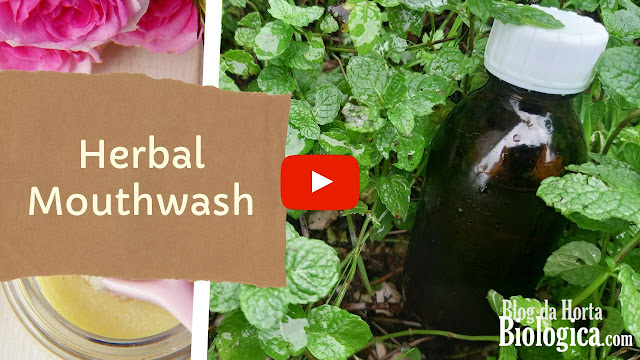
    Herbal Mouthwash | Homemade Mouthwash with Organic Herbs

    Almost anything can be made from plants! It's great to know that we can make our own products at home with simple, natural ingredients that respect our health and the environment...precisely because they come from it! So, today we are going to share with you our recipe for mouthwash with organic plants that are excellent in mouth and throat health care. Great news for those who don't want to spend too much money on the synthetic elixirs that are to be found in supermarkets! At the end of this post you can also watch our step-by-step video of this recipe.


    For this mouthwash, we used plants that we harvested in our own garden. 

    So let's see what the ingredients are and why to use them.


    Ingredients

    • Spearmint (Mentha spicata): 1 small stem is enough.
    • Parsley (Petroselinum crispum): 1 small stem is enough as well.
    • Lemon tree leaf (Citrus limon): 1 leaf. It is important that the leaf is new and tender, and that it is clean and free of pests and diseases.
    • Rosemary (Rosmarinus officinalis): as needed.
    • Fennel seeds (Foeniculum vulgare): as needed.
    • Baking soda: 1/4 tsp.
    • Tea Tree essential oil: 4 drops.
    • Water: enough to make an infusion.


    The plants used in this recipe can be fresh or dried. We used a mixture. The mint, parsley and lemon tree leaf were freshly picked. The rosemary and fennel seeds had been previously picked and were used dried.


    We created this recipe for a 125ml / 4.22oz bottle. In case you are wondering what "a small stem" is, or what the "as needed" or "enough to make an infusion" actually mean, watch the video below so that you will be completely enlightened.


    Why These Ingredients

    Spearmint: is excellent for the digestive system and helps keep a fresh breath.

    Parsley: also fights bad breath and soothes mouth irritation.

    Lemon tree leaf: has anti-inflammatory properties and helps ease canker sores, gingivitis, and relieve throat inflammation.

    Rosemary: is antibacterial and anti-inflammatory. It improves breath and relieves inflammation in the gums.

    Fennel: also has excellent properties for the entire digestive system and is expectorant.

    Baking soda (Sodium bicarbonate): very effective in oral hygiene. It relieves inflammation in the mouth and helps reduce stains on the teeth, keeping them cleaner and whiter.  

    Tea Tree Essential Oil: the champion of the antibacterial essential oils, with great power to disinfect the mouth and helps keep the breath fresh for longer.


    The plants present in this recipe can be changed as long as they have adequate properties for good oral hygiene.

    Learn more about the properties and uses of these and many other plants in our book: "The 5 C's of Aromatic and Medicinal Plants: Cultivate, Care, Collect, Conserve and Consume -  30 Plants and Their Properties".


    Required Materials

    • Kitchen tools for making an infusion.
    • 1 medium-sized glass jar for mixing various ingredients.
    • 1 spoon.
    • 1 funnel.
    • 1 small amber glass bottle with a wide lid. It is advisable to be an amber bottle to better preserve the liquid with essential oil.


    Method

    Now that we have all the ingredients and know why we should use them, let's see how to prepare the mouthwash:

    1. Start by preparing an infusion. The herbs should stay in the water for 5 minutes.
    2. Pour the equivalent of 125ml / 4.22oz into the medium-sized glass jar and let it cool completely. The remaining infusion can be used to prep more mouthwash bottles or for drinking. This is a very nice blend and makes a wonderful tea!
    3. After it has cooled, add 1/4 tsp of baking soda to the infusion and mix well.
    4. Add 4 drops of Tea Tree essential oil (aka Malaleuca) and mix well.
    5. Using a funnel, pour the mixture into the amber glass bottle.
    6. Ready to use!


    How To Use and Conserve

    The amount of mouthwash placed in the lid is sufficient for rinsing and gargling.

    Ideally, you should use it once a day.

    Shake the bottle well before each use.

    It cannot be ingested due to the presence of the essential oil.

    This mouthwash lasts up to 2 months. It does not require refrigeration, but can be stored in the fridge for cooler use.


    We hope you enjoyed our recipe! Have a look at our video with all the details and if you haven't subscribed to our YouTube channel yet, take the opportunity to do so if you don't want to miss a thing!


    VIDEO - Herbal Mouthwash | Homemade Mouthwash with Organic Herbs


    Coconut Soap For The Skin: Benefits and How To Make It

    Coconut soap has many benefits for the skin and hair, as well as many other ways to use in household cleaning and gardening. However, it is important to know that coconut soap is made differently for self-care and for home and garden care. We've already shown here on the blog How to Make Coconut Soap for use as a natural insecticide. In this post, we'll show you how to make it to use in personal hygiene. At the end of this post, you may also watch our step-by-step video on how to make this soap.


    Benefits of Coconut Soap


    A 100% coconut soap contains coconut oil as its only fat. Coconut oil which is known to have numerous properties and various internal and external uses. 

    Although there is some controversy in the properties attributed to coconut oil, it is considered to be an excellent ally of skin and hair health. 

    So that this post doesn't get too long, we'll start by talking a bit about the benefits of coconut for external use, and then we'll show you how to make this soap. In another post, we will delve deeper into the properties of coconut oil.


    Skin


    • Moisturizer. Because of its nourishing properties, coconut soap helps to keep skin moisturized and to prevent excessive dryness.
    • Emollient. Helps maintain skin elasticity. The use of coconut on the skin has also been associated with relieving dermatitis and reducing allergies and other skin reactions.
    • Anti-aging. Because of its high concentration of antioxidants, including vitamin E, it helps prevent premature aging.
    • Deep cleansing. Coconut soap is very effective in cleansing the skin, helping to remove makeup very well, clean pores and eliminate residues.


    Hair


    • Lubricant. Because it is so rich in vitamin E, triglycerides and fatty acids, coconut moisturizes and adds shine to hair, forming a lubricating film on the strands, preventing dryness and helping in the recovery of dull and damaged hair.
    • Against hair loss. Although not many studies have been done on this subject yet, coconut is considered to help strengthen hair strands and improve the appearance of hair ends.
    • Deep cleansing. It cleanses the scalp very well while maintaining its natural fat layer. In addition, coconut has anti-bacterial properties that help maintain the health of the scalp.


    Although all these properties are attributed to coconut oil, it is always good to remember that, in case of skin diseases, it is imperative to see a dermatologist before trying any product on the skin.


    Important Info on Soap Making


    If you have never made soap at home, it is important to know more about soap making and safety rules before moving on to the recipe. This information is very important and can also be found in our posts: How To Make Coconut Soap – Cold Process Step-by-step and Its Various Ways of Use and Olive Oil Soap: How to Make It and Its Benefits. In this post we will remind you of important information about soap making and explain the difference between this soap and coconut soap used as a natural insecticide.


    What Is Soap?


    Soap is a salt of fatty acids that is obtained through the chemical reaction between a fat and alkali. This reaction is called saponification. 

    The mandatory materials for making soap are alkali (sodium or potassium hydroxide), fats (oils, butters and waxes) and water (distilled - do not use tap water).


    Cold Process


    This recipe is made by the cold process, in which all the ingredients are handled at low temperatures, in contrast to the hot process in which a crock pot is used.

    In the cold process it is easier to control the final result. However, the time to cure is longer.


    What Is The Cure?


    The cure is the necessary time for soap to lose water and stabilize the pH. The curing time for a 100% coconut soap for the skin is 6 weeks.


    How To Know The pH?


    Soap, in a cold process, is alkaline and the pH varies between values 8 and 10. During the curing process, pH measuring strips can be used to know whether the soap needs to cure for a longer time.

    For more info, visit our post: How To Test the pH of Soap


    Superfat


    Superfat is the extra fat in soap so that it is emollient and doesn't hurt the skin. 


    Coconut Soap For The Skin vs Coconut Soap For Cleaning


    Coconut soap for the skin does have superfat in its formula. This means that it is a soft soap and can be used safely on both skin and hair.

    Coconut soap for cleaning does not have superfat in its formula. This means that coconut soap for cleaning is aggressive for the skin, for it has the capacity to remove its natural fat layer. On the other hand, it is excellent for cleaning due to its detergent power and capacity to remove grease and dirt. 


    Mandatory Safety Equipment


    Due to the handling of caustic soda, it is necessary to take special care. This is the mandatory safety equipment:


    Ingredients For This Recipe


    *The essential oils are optional. If you have sensitive and reactive skin you can make this recipe without the essential oils. 

    This recipe will yield about 600g of soap. The weight will always vary after curing.


    Materials Needed To Make This Soap Recipe


    * This container is optional, as the cold water bath can also be made in the sink, if it has enough space.


    Important Safety Rules


    • Work without distractions. Do not eat, drink, smoke, watch TV, listen to radio or answer the phone. Have no children and pets around. 
    • When weighing ingredients, always round the values down, never up.  
    • Never use aluminum, as it reacts with caustic soda.
    • Handle the hydroxide in a well ventilated area, using the safety equipment. 
    • Have vinegar at hand because, in case of spillage, it cuts the effect of soda.
    • Wash utensils only 24h later. Use gloves, as it will still be very caustic.


    Step-By-Step (Video At The End)


    1. Gather all the material.
    2. Weigh the ingredients.
    3. Due to the volatility of the essential oils, you must cover their container with a cloth or a lid.
    4. Put the oil on the heat.
    5. While the oil is heating up, very carefully add the hydroxide over the water, never the other way around! 
    6. Dissolve the hydroxide with a stainless steel spoon. Never aluminum!
    7. Measure the temperatures of each solution and use a cold bath to control the temperatures. 
    8. As soon as both solutions are at 45ºC (both must be at the same temperature or with a maximum difference of 10ºC), add the water to the oil. Never the other way around! 
    9. Mix first with a spatula and then with a hand blender (exclusive for this purpose).
    10. Add the essential oils.
    11. Mix with the hand blender until reaching the trace.
    12. Pour the batter into the mold and with the help of the tray shake the mold to remove air bubbles that might be in the batter.
    13. Wrap the mold with cling film and a cloth to help maintain the temperature. 
    14. Isolate for 4h, without disturbing, until it hardens. 
    15. After 4h unmold and proceed to cut (if it's a bar). For unmolding it is advisable to wear gloves.


    What Is the Trace?


    The trace is the point in the soap making process when oil and lye water have emulsified, that is, the point where water solution and oil mix together and form a viscous batter in which it is possible to identify lines (trace) when passing the spatula or hand blender through. 


    How To Store?


    During the 6 weeks of curing of coconut soap, the soap bars should be stored in a place without direct sunlight and without dampness. The bars must be rotated, so that they can cure evenly.

    It is very important to make a label with the date the soap was made and the approximate date of the cure, for better guidance.

    The soap should only be wrapped after it has cured, using natural materials. 
    Cotton bagscardboard boxes, paper to wrap the soap or fabric can be used, so that the soap can maintain its quality for a longer time. The first sign that the soap is deteriorating is when yellow stains appear with a rancid odor.

    If the soap is used immediately after the cure, it should be placed in soap dishes, so that water can drain and the soap can last longer. If left in water, the soap will breakdown more easily.


    Some Suggestions To Store Soap


    How To Use This Soap?


    This soap can be used like all other soaps that are made for cosmetic use:

    • Hands
    • Face
    • Body, to replace shower gel
    • Hair, to replace liquid shampoo. It is important to remember that hair is always a complicated matter, so this soap (or any other) may have excellent results for some people and fall short for others, if the purpose is to use it as a shampoo. 

    Making this soap is a great way to preserve the environment and reduce plastic packaging, which makes it a "zero waste" product. Nature thanks you, and so does your health!

    With this post we hope to help all those who seek a simple and natural life.


    Check out our video below, and if you haven't subscribed to our YouTube channel yet, take the opportunity to do so, if you don't want to miss a thing!


    Materials We Use And Recommend For Their High Quality


    Video - Coconut Soap for the Skin | Steb by Step Tutoral for Beginners | Cold Process 


    How To Make Hydrosol with an Alembic

    Hydrosols are delicate floral waters and, in addition to their aroma, they contain the medicinal properties of the plants. In our post How to Make Hydrosol | Floral Water we explained what hydrosols are and how to make them at home, in a simple way using not much more than a pot. In this post we will show you how to make hydrosol using an alembic, which allows for a more efficient distillation and a higher yield.

    At the end of the post you can also watch our educational video where we show you how to do it step by step. If you already make hydrosols at home and want to know how to preserve them, please visit our post How To Preserve Hydrosols and Prolong Their Shelf Life.


    The alembic we used for this post and video is a small 10L alembic that does not have a column for steam distillation, so the plants were placed inside the boiler in contact with the water to do a hydro-distillation.

    The plant we chose was lavender (Lavandula stoechas), but you can use other plants you are interested in. 


    The Alembic


    For those who want to start using the alembic, here are the names of its components:


    How To Make It


    All flowers, stems and leaves can be used. However, because most of the aromatic molecules are found in the flowers of this plant, and because our alembic is small, we have used only the flowers.

    The stems and leaves can be used, for example, to make natural incense.


    Here’s how we make our lavender hydrosol.

    1. We place the flowers inside the boiler and take note of the weight of the flowers.
    2. Then we put distilled water in, using a ratio of 3 parts of water to 1 part of plant. With the plant and water inside, the boiler is ready to go on the stove.
    3. We cover and join the helmet and condenser tubes. The joints of these tubes can also be sealed with Teflon tape.
    4. We turn on the stove and wait for the water to start boiling.


    The Distillation Process


    This is what happens during the distillation process.

    1. As the water boils, steam will rise, pass through the condenser tube (also known as the gooseneck) and descend to the condenser coil. The condenser is filled with cold water. During the whole process, the water in the condenser is kept cold by circulation through a pump, which can be an aquarium pump. This pump must be placed in a tank where the water can be kept cold. This can be a bucket, bowl or sink. To keep the water cold throughout the process, cold accumulators or ice cubes can be used.
    2. The water comes out from the top of the condenser, goes to the pump tank and is pumped back to the condenser. It is advisable that this pipe has a flow regulating valve, so that the water slowly flows back in from the bottom of the condenser.
    3. The cold water will condense the vapors that are inside the coil, and the hydrosol will start coming out.
    4. The floral water must come out into a jar, preferably made of glass. This jar must have a funnel and a coffee filter to prevent plant residues from getting into the hydrosol.
    5. After about 1h30 we turn off the stove and wait until no more hydrosol comes out.
    6. Then we wait for the alembic to cool down, remove the plant and rinse the alembic  with alcohol. The alembic must be kept very clean and dry until the next use.


    When doing all this process it is important to record some data such as the weight of the plant and the final yield of the hydrosol. In this process we used 337g of plant and obtained about 700ml of hydrosol.

    To learn how to store the hydrosol correctly so that it lasts for a long period of time, read our post How to Store Hydrosols and Prolong Their Shelf Life.


    For a better understanding, here’s our video where we show this process step by step. If you like our videos and haven't subscribed to our YouTube channel yet, take the opportunity to do so if you don't want to miss a thing!


    VIDEO: How To Make Hydrosol with an Alembic


    How To Preserve Hydrosols and Prolong Their Shelf Life

    Hydrosols are floral waters of fragile nature and must be stored properly if they are to be used over a long period of time. Hydrosols are not as concentrated as essential oils, nor do they have the same antibacterial power, which makes them subject to a faster deterioration. Still, in order to enjoy their aromas and therapeutic properties for longer, it is worth knowing how to preserve them.

    We have already shown, here on the blog, how to make hydrosol and how to make hydrosol with an alembic. In this post we will give several tips for storing these delicate aromatic waters.


    Check out our infographic with all the information for preserving hydrosols.


    Infographic How To preserve Hydrosols de Blog da Horta Biológica


    Some Items For Storing Hydrosols Properly


    How to Know If The Hydrosol has Gone Bad

    When the hydrosol is contaminated or its shelf life has ended, you can identify a white matter floating in the water. This matter, which can sometimes also be dark, is nothing more than a mold stain that forms in the water. In transparent bottles it is easier to identify the presence of mold in the water. A total absence of aroma may also be an indicator that the hydrosol has lost its properties and should no longer be used.


    What to Do With Expired Hydrosols

    Hydrosols should not be discarded. They can be used to water the plants or can be added to the compost pile.


    And this is how you preserve hydrosols for a long time! With all this information we hope everyone can get the most out of their plants. 

    Until the next post, take good care!


    DIY | Natural Moisturizing Cream | Step by Step Tutorial | Recipe for All Skin Types

    At the request of several of our readers and subscribers, today we bring you a recipe for a homemade moisturizing cream. We have already shared here on the blog our very simple recipe for Homemade Natural Moisturizer with 3 ingredients only, but in today's post, we will teach you how to make a moisturizer from scratch. The recipe we created for this post can be used on all skin types. At the end of the post, also check out our educational video with step by step instructions for this recipe.


    Before jumping into to the recipe, it is important to get some basic knowledge about the formulation of a cream. The purpose of this post is not to teach how to formulate, but to understand, in a simple way, how a cream is made. So, let's get by parts...


    Phases of a Cream


    Making a real cream involves several distinct phases. Let's look at each one.


    Oily Phase


    In this phase, in a glass container, the fats are added: vegetable oils, waxes and/or butters. This is when you must choose the ingredients that best suit your skin type. So that this recipe can be made at home by as many people as possible, we chose jojoba oil, since it can be used on all skin types. However, as an example, here are some easy-to-find vegetable oil alternatives for each skin type:

    Dry skin: olive oil, coconut oil or sweet almond oil

    Oily skin: grapeseed oil

    Acne-prone skin: argan oil or St. John's wort maceration*

    Combination skin: grapeseed oil

    Sensitive skin: sweet almond oil or calendula maceration 

    Mature skin: argan oil, evening primrose oil or Rosehip oil aka Sweet briar*


    *These vegetable oils cause photosensitivity, so they should only be used in night creams.


    The purpose of the oily phase is to nourish the skin and balance its texture.


    Aqueous Phase


    In this phase, in another glass container, distilled water and other water-soluble ingredients are included. In smaller proportions, you can include hydrosols or floral waters, plant infusions, etc. This is also the phase in which a humectant agent such as vegetable glycerin is added.

    The purpose of the aqueous phase is to hydrate the skin and maintain its elasticity.


    Emulsion
     

    Since fats and water do not blend, it is necessary to include an emulsifying agent that allows the molecules of both solutions to bond. There are various emulsifying waxes, some are more suitable for thin, light creams, others for thicker creams. The emulsifying agent is added to the container of the oily phase.


    Additives


    After the emulsion, important additives are added, such as antioxidants, preservatives and essential oils with active principles suitable for each skin type. Again, and so that this cream can be made fearlessly, we have created a recipe with essential oils for all skin types, lavender and rose. Here are some essential oil alternatives for each skin type:

    Dry skin: ylang ylang, neroli

    Oily skin: tea tree, rosemary, cedarwood

    Acne-prone skin: sage, geranium, cypress

    Combination skin: palmarosa, frankincense

    Sensitive skin: lavender and roses are also recommended

    Mature skin: sandalwood, myrrh


    Now that we have talked about the phases of a cream, let's move on to the materials and ingredients needed for this recipe.


    Materials


    To make it easier to gather all the materials, here's the list:

    • Precision scale
    • 1 Heat-resistant glass container for the oily phase
    • 1 Heat-resistant glass container for the aqueous phase
    • Glass containers for weighing the additives
    • 1 stainless steel pan
    • Silicone spatulas
    • Pipettes (in case the containers of the ingredients do not have a dropper)
    • 1 Milk frother 
    • 1 Feed syringe (optional)
    • 1 Glass container with lid to store the moisturizer


    Ingredients


    This recipe results in about 50g of cream and these are the ingredients:


    Oily Phase


    Aqueous Phase


    Additives


    Making natural products at home gives us greater control over the quality of the final product because we can customize and choose the most suitable ingredients for ourselves. To get a real idea of the importance of what we put on our skin, we suggest reading our post: Understanding Cosmetic Chemicals


    Understanding These Ingredients and Their Functions


    Simply and briefly, let's look at what each of these ingredients does.


    Jojoba Oil 

    This oil is actually a liquid wax with regenerative properties and its composition closely resembles the skin's natural fat. It is suitable for all skin types and is quite stable and long-lasting, which means that it does not go rancid easily. For all these reasons, we chose this oil for this recipe.


    Beeswax

    We put beeswax in this recipe at the request of one of our readers and it may also be a useful way to use this wax for those who, just like us, have home production. In a cream, beeswax should be used in minimal amounts, otherwise the cream will become too greasy and thick. We do not recommend using more than 1% of the total recipe or formula, especially for those with oil-prone skin. 

    If you do not want to add beeswax to your cream you can remove this ingredient from the recipe and add the equivalent in jojoba oil. 


    OliveM 1000

    This is an emulsifying wax, flaked, derived from olive oil. There are other emulsifying waxes, but this is one of the most suitable for creams as it creates a fine, stable emulsion that is very well absorbed by the skin.


    Distilled Water

    Distilled water is used to formulate cosmetics because it is free of mineral salts and other substances that can cause reactions with other ingredients and jeopardize the final result.


    Vegetable Glycerin 

    It is the humectant that retains water in the emulsion and helps keep the skin hydrated for longer.


    Vitamin E

    In addition to its many beneficial properties for the skin, it also works as a preservative agent for fats, extending their shelf life.


    Grapefruit Seed Extract

    Since a cream takes water in its composition, it is necessary to add a preservative that prevents the appearance of fungi and bacteria. For this recipe we chose grapefruit seed extract because it is a natural preservative. There are some laboratory-made preservatives on the market that, due to their less aggressive composition, are accepted in natural cosmetics. These preservatives are able to extend the shelf life of products for longer. However, because we make our products at home, we prefer this extract because it is totally natural. We will talk about the preservation of this cream at the end of the post.


    Lavender Essential Oil

    Just as we were careful to choose a vegetable oil for all skin types, we also chose essential oils that can be used by everyone. Lavender is one of the most versatile and gentle on the skin. 


    Rose Essential Oil

    In this recipe we put a very special finishing touch. 1 drop of rose essential oil. Along with lavender, roses are one of the most versatile and powerful plants when it comes to skin care. We advise you to read our post: Rose Water: Benefits and How to Make It for more information about the properties of roses. 

    Pure rose essential oil is highly concentrated and 1 drop is enough for this amount of cream. If you don't have this essential oil you can replace it with another one or you can add nothing else.


    Here we would like to thank our dearest friend Kalinka Hristova (intobulgarian.eu) from Bulgaria who so kindly gifted us with pure and very high quality rose essential oils produced in her beautiful country. Our many thanks and a big hug to Bulgaria!


    Recipe


    Now let's get to know the recipe. 


    Oily Phase
    1. On a precision scale, weigh out the beeswax and the OliveM 1000 emulsifier.
    2. In a heat-resistant glass container, weigh the jojoba oil. These fats are weighed separately because beeswax and OliveM 1000 are dry to the touch and jojoba oil is liquid. Thus, in case of error, you can remove the excess without the dry elements being soaked in oil.
    3. After weighing all the fatty ingredients, add the wax and the OliveM 1000 to the jojoba oil in the heat-resistant container. Thus, you have your oily phase ready.


    Aqueous Phase
    1. Always on the precision scale, weigh the glycerin.
    2. In a heat-resistant glass container, weigh the distilled water. Again, weighing is done in separate containers in case the liquids overflow.
    3. After weighing the aqueous ingredients, add the glycerin to the water in the heat-resistant container. Thus, you we have you aqueous phase ready.


    Weigh the Additives

    1. In different containers, weigh out the vitamin E, grapefruit seed extract, and lavender essential oil. The rose essential oil doesn't need to be weighed, as it's just one drop.


    Bring To a Boil

    1. Place the two heat-resistant containers in a hot water bath in the same pan.
    2. Once the fats melt, remove the containers from the heat.


    Emulsion

    1. Immediately after removing from the heat, add the water phase over the oil phase. Water over oil, as it's done in soap making.
    2. Stir with a milk frother to emulsify. At this stage, you can place the container in a cold water bath to help emulsify faster.


    Add the Additives

    1. Let the emulsion cool down a bit, and before it gets thick, add the additives. In between each additive, you can stir a little more so that they are well incorporated. 


    Store

    1. Once the emulsion is cool, transfer it to a container. A spoon, a silicone spatula, or a feeding syringe can be used for this task.


    Conservation


    This cream does not require refrigeration, but keeping it in the refrigerator will help extend its shelf life. Since the preservative is natural, the cream should last about 4 weeks before it starts to go bad. It may last longer, or shorter, depending on the conditions in which it is stored. 

    Tip: Because it is so delicate, this cream is intended for facial use. However, body skin also benefits greatly from these ingredients. So, in case the cream's shelf life is already passing 4 weeks and there is still a lot of cream left in the container, in order to avoid waste, the cream can be used more on the body than on the face so that you can finish it before it goes bad.


    Warning

    • People with very sensitive/reactive skin, babies and pregnant women should avoid using essential oils. This cream can be made the same way, removing the essential oils at the end.
    • When making homemade products, even though all the ingredients are natural, it is important that you check beforehand whether you are allergic to any of the components. The homemade recipes can be changed according to the needs of each person.


    Many thanks to our readers who give us tips on things they want to learn. With your help, our blog is getting richer in content. It is by sharing that knowledge is built!

    Xo Xo

    Ana and Luís